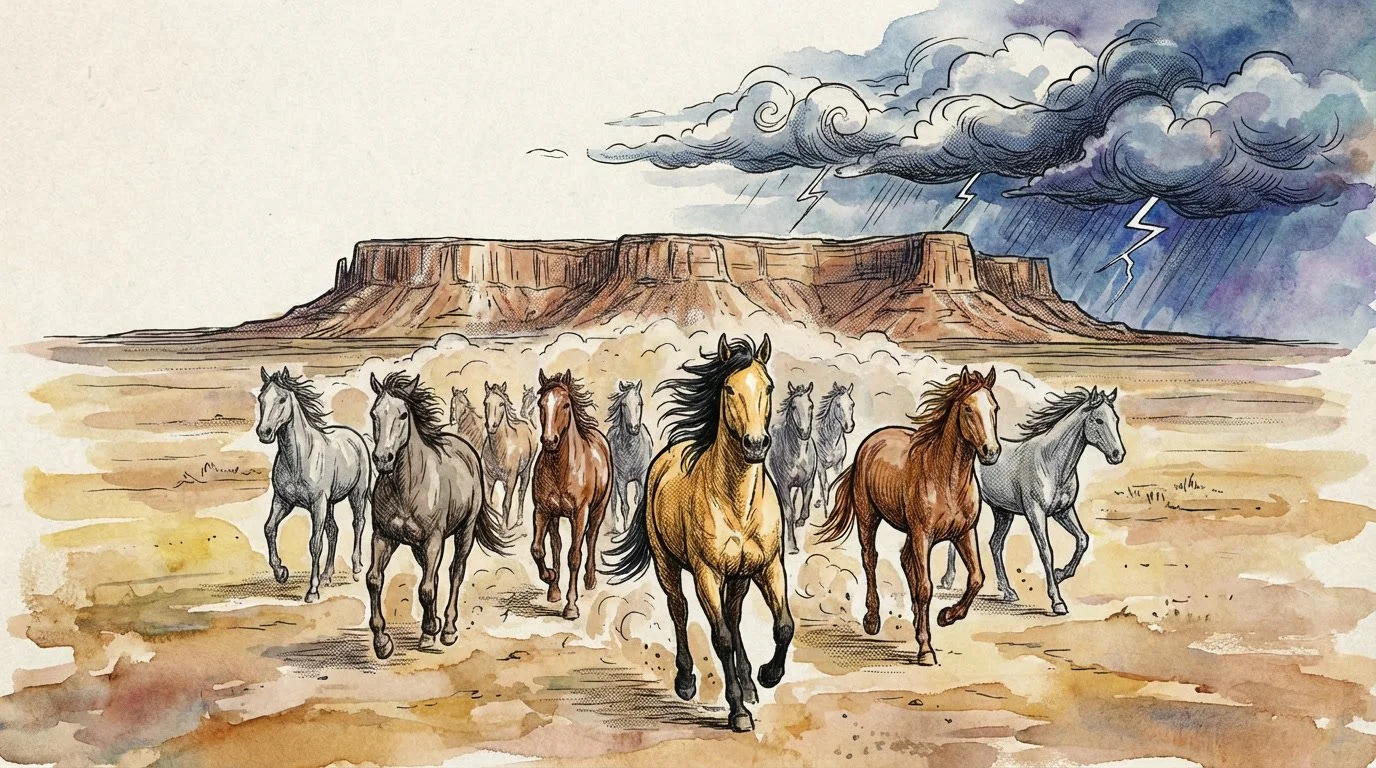
When the sky turns, a horse’s greatest asset is space. By prioritizing expansive acreage and proactive land management, we provide our herds with the freedom they need to outmaneuver the elements.
Fast Facts: High-Stakes Preparedness at a Glance
Identification: Layered approach—microchips for permanence, livestock crayons for immediate visual ID, and GPS for tracking.
Tracking: Braid AirTags for local proximity; deploy Satellite GPS for horses on expansive or remote acreage.
Training: "Stress-loading" protocols involving sirens, chainsaws, and trust-based blindfold loading.
The 72-Hour Rule: Decentralized forage and water caches across multiple sectors to bypass "single point of failure" barn storage.
Evacuation: Treat a "Warning" as an "Order"—the 48-Hour Early Departure is the only way to move large herds safely.
The 250+ Acre Buffer: Large-scale estates act as regional anchors, providing heavy machinery, fire breaks, and high ground for the community.
Silvopasture & Forestry: Active management of fuel loads and "dead-fall" creates a natural fortress against wildfire and wind.
The Evolution of the "Good Owner"
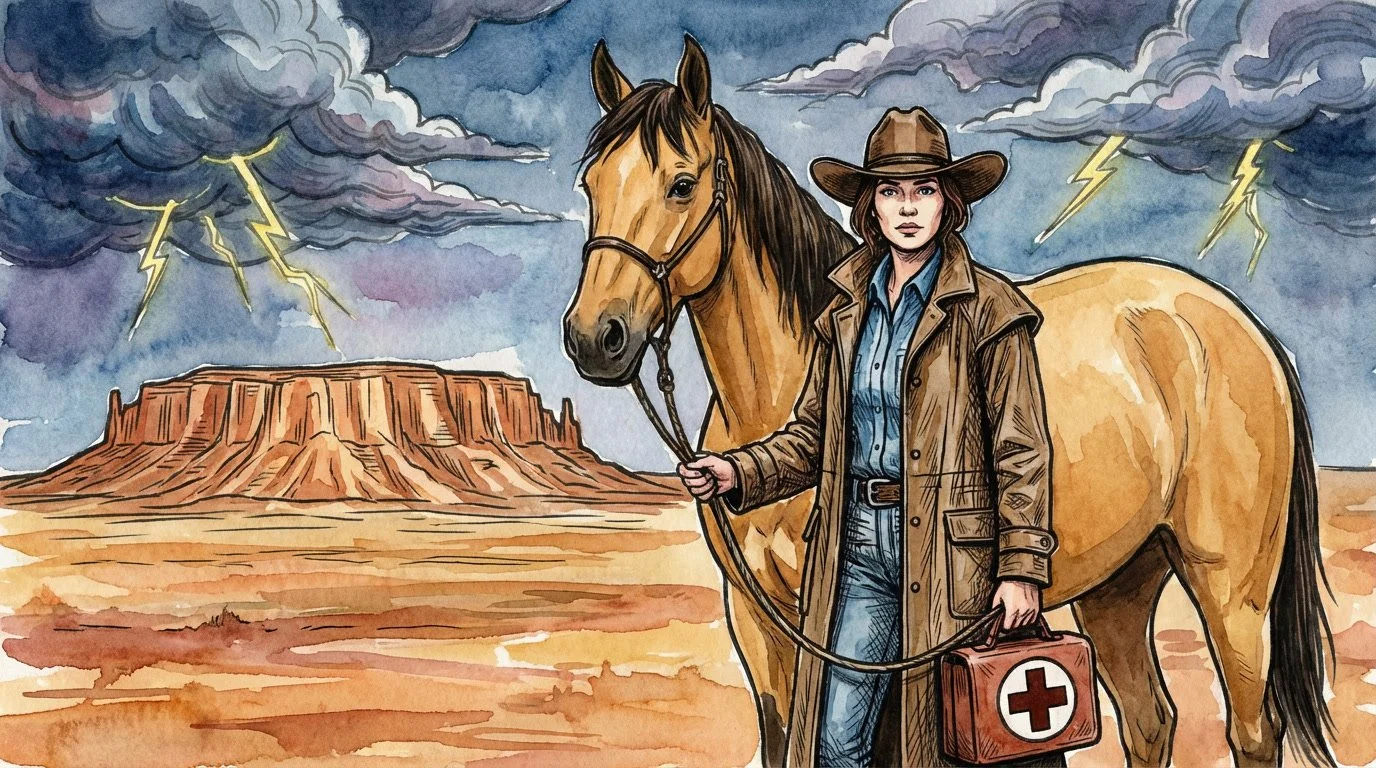
The definition of a 'good owner' is evolving from daily care to active stewardship; it’s a shift from merely maintaining a stable to managing a resilient, 250+ acre landscape that serves as a high-ground sanctuary for the entire community. True preparedness means scaling our vision to meet the environment, ensuring that when the rhythm of chores is broken by a crisis, our infrastructure is already standing guard.
For every horse owner, the "perfect day" is defined by quiet pastures and a steady rhythm of chores. But as the climate shifts and unpredictable weather patterns become more frequent, the definition of a "good owner" is evolving. It is no longer enough to simply have a first-aid kit in the tack room and a trailer in the driveway. True equine disaster preparedness requires a proactive strategy that scales to fit your environment.
Whether you are boarding your horse at a local stable, living on a single acre, or managing a sprawling horse sanctuary, the fundamentals of safety remain the same. The responsibility to protect these animals transcends property lines. However, by looking at the 250+ acre stewardship model, we can see how larger-scale land management provides a "safety buffer" for an entire region.
Our vision is to get more people on board with these large-scale estates—not as an exclusive club, but as community hubs. These are places that can offer high ground, heavy machinery, and emergency resources to neighbors on smaller parcels. Managing horses in a crisis is a logistical marathon. When the power fails, well pumps go silent; when trees fall, fences fail; and when the smoke or water rises, the very barns we built for protection can become a liability. By combining modern tracking technology, stress-tested training, and community-centric logistics, we can build a future where every horse is protected by a system designed to weather any storm.
1. Reliable Identification and Records: The Digital & Physical Layer
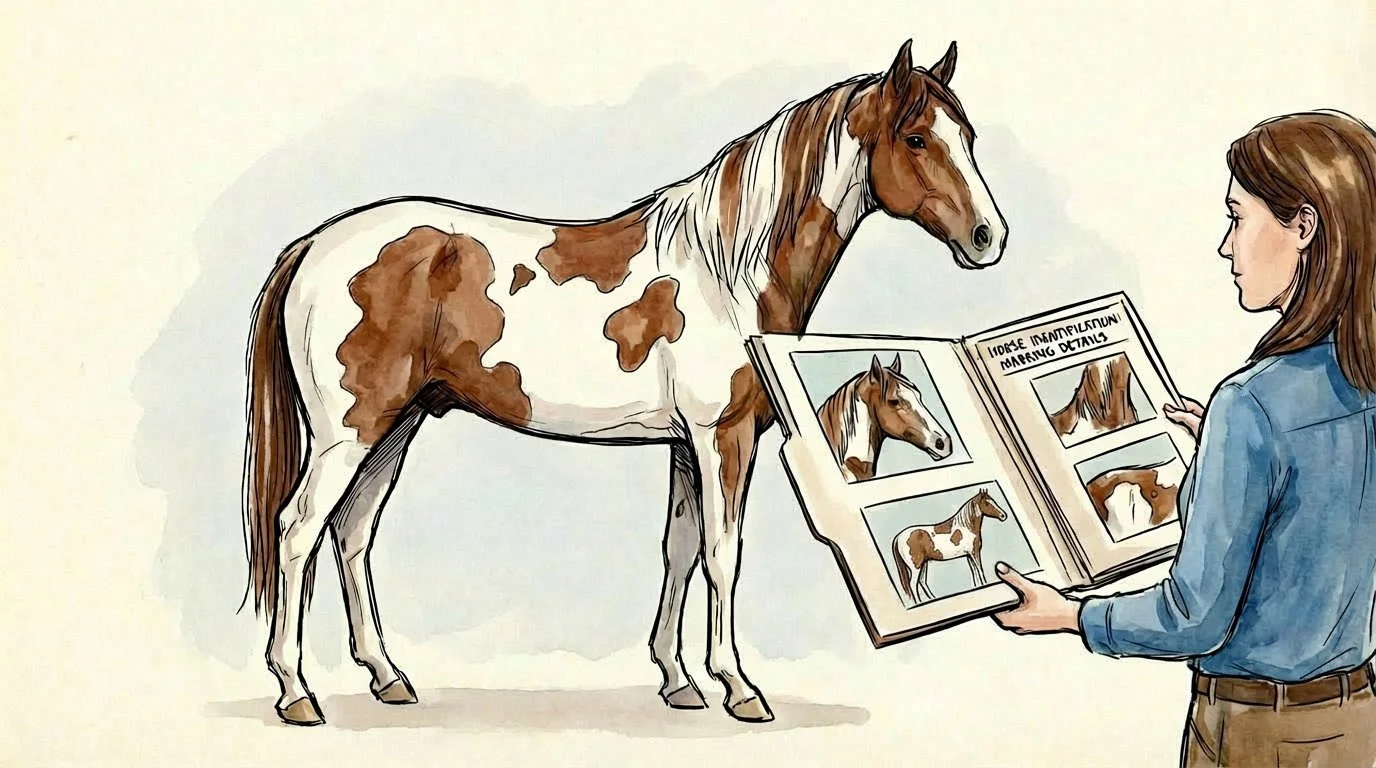
To ensure a seamless reunification during a disaster, maintain a 'Digital Vault' or physical binder with detailed four-view photographs and clear records of unique markings, providing irrefutable proof of ownership when microchips alone aren't enough.
When horses are managed in larger herds or across expansive acreage, permanent and visible identification is your first line of defense during a separation. In a disaster, a horse's identity is their ticket back home.
Visible ID (The Immediate Layer): In a crisis, rescuers won't always have a microchip scanner. Use luggage tags braided into manes, or "paint branding" your phone number on the horse’s coat with a Livestock Marking Crayon. This ensures that even from 50 feet away, a first responder knows exactly who to call.
Microchipping (The Permanent Layer): Ensure microchips are registered in a national database. For large-scale stewards, maintaining a master list of chip numbers in a cloud-based folder is non-negotiable.
The Digital Vault: Keep a "grab-and-go" binder (and a synced digital backup) with Coggins tests and "four-view" photos. These photos should include any unique markings or scars to prove ownership beyond a doubt during a chaotic reunification process.
2. High-Tech Tracking: Bridging the Gap Between Bluetooth and Satellite

Don’t let a dead zone be the reason you can’t find them. AirTags are great for crowds, but in the rural "wild," they’re often silent. Remember: AirTags need other phones to work; Satellite GPS talks directly to the sky. If you live in a rural area, stick with the satellite
If a horse gets loose on a large property or breaks away during a frantic evacuation, technology can save days of searching. On a 250+ acre property, a horse can disappear into a ravine or woodlot in minutes.
Apple AirTags (Local Proximity): These are excellent for "crowdsourced" tracking. You can easily braid an AirTag into a horse's mane using a small Silicone AirTag Holder. Note: AirTags rely on the Find My network. They are brilliant for the "last mile" of searching, but may fail in truly remote wilderness where iPhones are scarce.
Satellite GPS Trackers (Remote Security): For true peace of mind on large acreage, consider a dedicated satellite tracker, such as the Tractive GPS for Animals. These devices communicate directly with satellites, providing real-time location data regardless of cellular service. For the large-scale steward, having 2–3 of these units ready to swap onto horses during an "active threat" window is a critical investment.
3. Medical Readiness: The "Everywhere" Kit Strategy
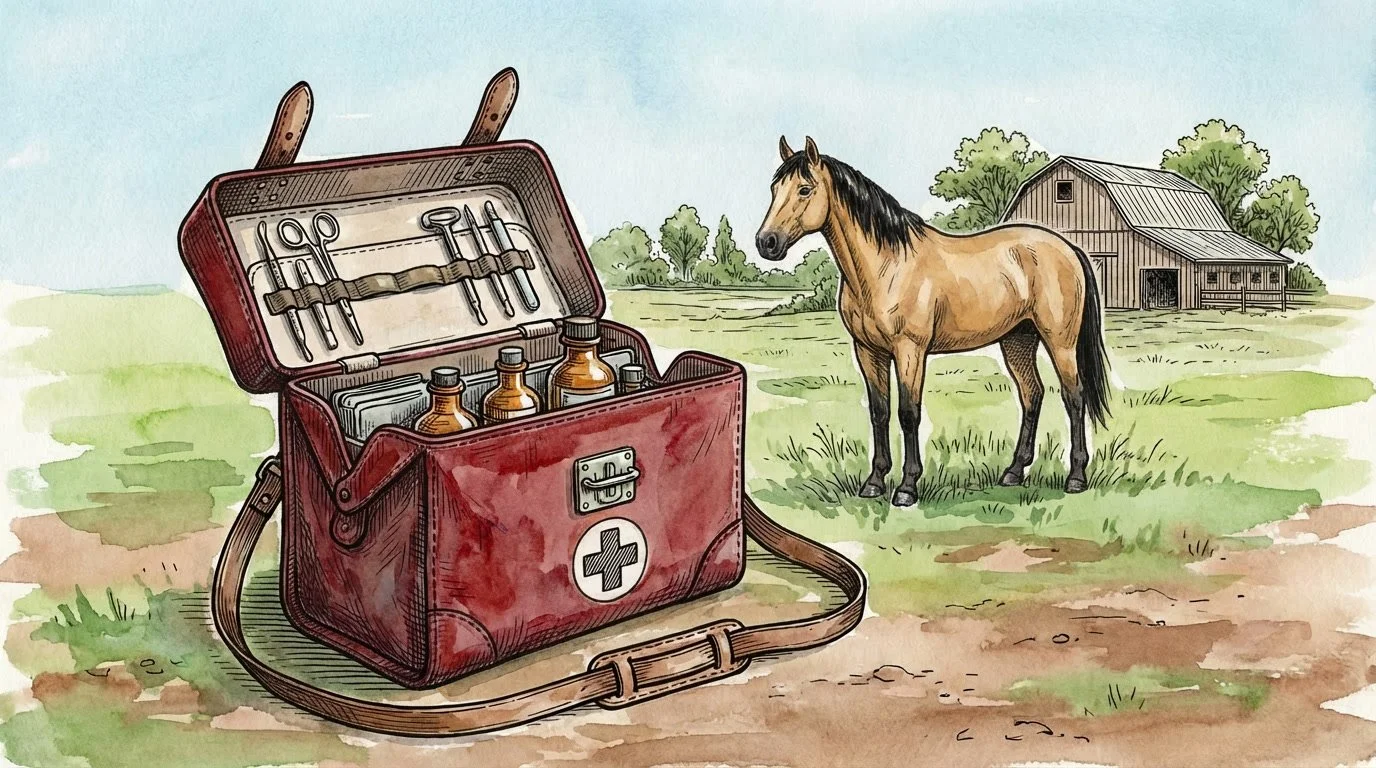
When disaster strikes, accessibility is everything. Maintaining multiple, portable medical kits—stashed in your barn, truck, and emergency go-bags—ensures you are never more than a few steps away from life-saving supplies; because in an emergency, you can truly never have too many.
A single first-aid kit in the main tack room is a "single point of failure." If a tree falls across the path to the barn, your medical supplies are effectively locked away.
The Primary Hubs: Always maintain a fully stocked, professional-grade medical kit in both your main barn and your primary evacuation vehicle.
Sector-Based Caches: On larger estates, you should stash "mini-kits" in weather-proof Pelican cases at various points—ATVs, remote equipment sheds, or even fence-line "emergency boxes."
The "Extra Extras": Every kit should include the "Big Three": vet wrap, sterile gauze, and heavy-duty wire cutters. You can find great Pre-Packed Equine First Aid Kits to use as your base, but customize them with specific medications (like Banamine or Bute) as directed by your vet.
4. Stress-Testing Your Training: Preparing for the "Un-Trainable"
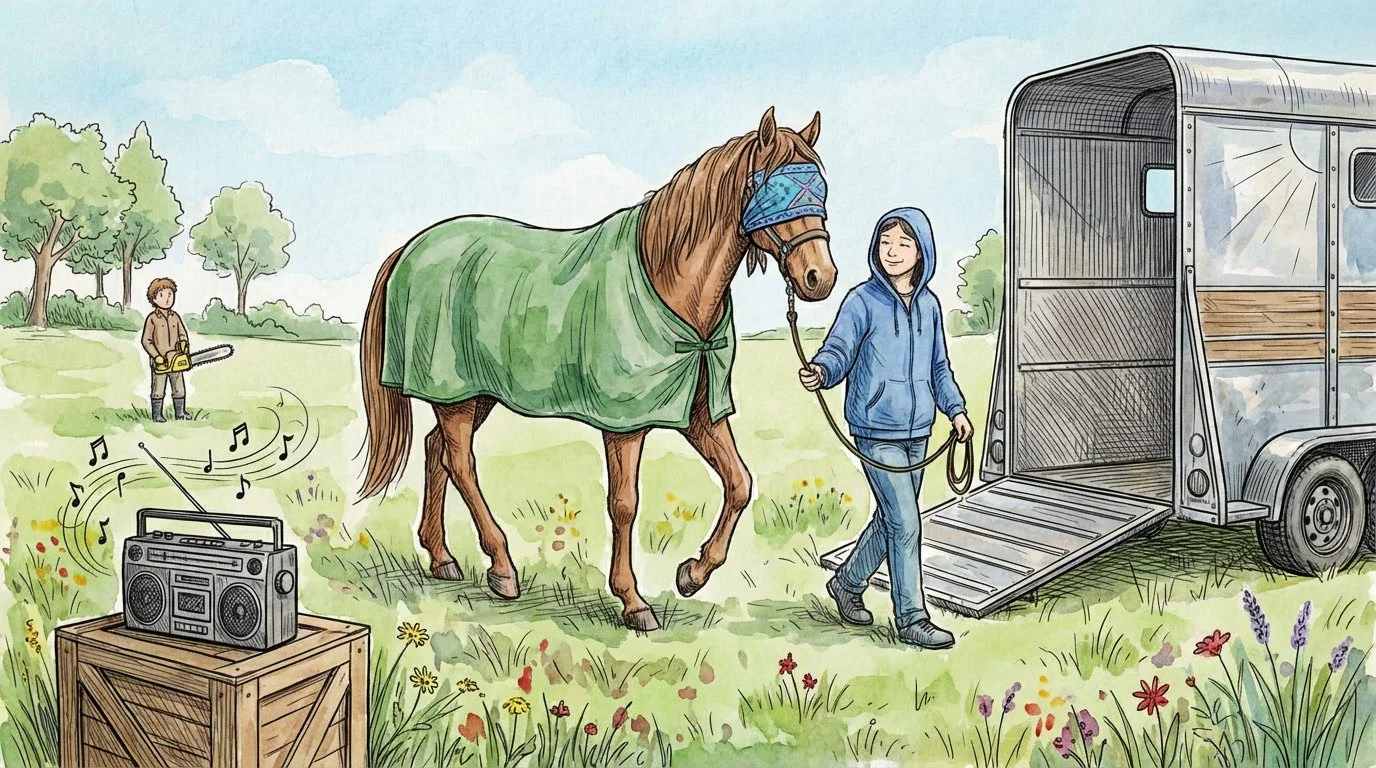
To ensure your horse remains reachable and responsive in a crisis, you must 'stress-test' your training by practicing blindfold loading amidst simulated chaos—like loud music and running chainsaws—long before an actual emergency forces your hand.
The middle of a storm is the worst time to find out your horse only loads when the sun is out, and the birds are singing. Training for a disaster means training for high-cortisol environments.
Simulate the Noise: Practice loading your horses while someone else creates a "controlled" disturbance nearby—think loud music, banging trash can lids, or even running a chainsaw at a safe distance.
Blindfold Training: In extreme smoke or fire, a horse may refuse to move toward a trailer because they can see the "danger." Practice putting a blindfold over their face and leading them into the trailer based entirely on their trust in your voice and touch.
The "Group Load" Dynamic: On properties with multiple horses, practice loading in pairs. In a disaster, horses will draw confidence from their herd-mates. If you can load your "anchor" horse (the calm leader), the others are much more likely to follow.
5. Shelter vs. Survival: The Strategy of Topography

In extreme storms, wildfires, or flood risks, the safest place for a horse is often a large, open pasture clear of old-growth timber or power lines, allowing them to utilize their natural survival instincts to find their own safe harbor rather than being trapped inside a barn.
In extreme windstorms, wildfires, or flood risks, the barn—historically our symbol of safety—can become a death trap.
The Large Pasture Strategy: On significant acreage, the safest place for a horse is often a large, open pasture clear of old-growth timber or power lines.
The Flood-Plain Reality: If you live on a floodplain and cannot transport your horses out in time, fences can become lethal. In a rising-water emergency, letting them loose completely is often the only way to give them a chance to find higher ground.
The Rules of "Turning Loose": If you must let them go, remove all blankets and non-breakaway halters. These items can snag on debris or become waterlogged, dragging a swimming horse down.
6. Forestry Management: Creating the Natural Fortress
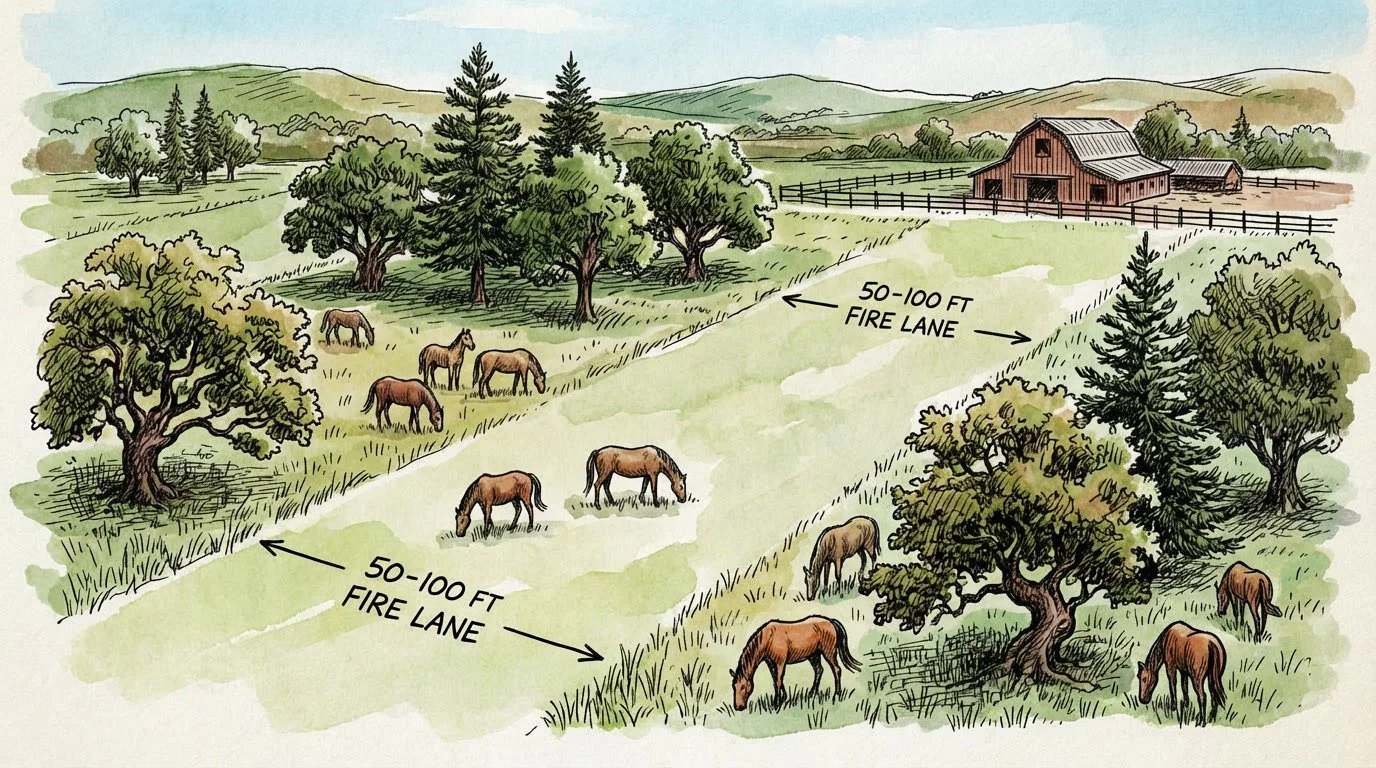
Active forestry management is your first line of defense; by maintaining clear fire lanes and reducing fuel loads on large acreage, you create a natural fortress that can slow the spread of wildfire and provide a critical staging area for emergency responders.
On any size estate, you aren't just managing horses; you are managing an ecosystem. Proactive forestry is the difference between a property that feeds a fire and one that stops it.
Fuel Load Reduction: Regularly clear "ladder fuels"—low-hanging branches and thick underbrush that allow a ground fire to climb into the canopy. High-canopy trees with clear ground below are far less likely to crown into a catastrophic fire.
Strategic Fire Breaks: Utilize your acreage to create 50-to-100-foot wide "fuel breaks." These can be disked dirt paths, well-grazed clover strips, or gravel access roads. These breaks give emergency crews a place to make a stand.
Silvopasture Integration: By thinning wooded areas to allow for grass growth (silvopasture), you create shaded grazing that is inherently more fire-resistant than a dense, choked forest floor.
The "Dead-Fall" Audit: After every wind event, audit your fence lines and transit paths. Old-growth timber near gates or barns should be professionally assessed. A single fallen oak can turn an 8-foot gate into an impassable wall during an evacuation.
7. Evacuation: The "48-Hour" Rule
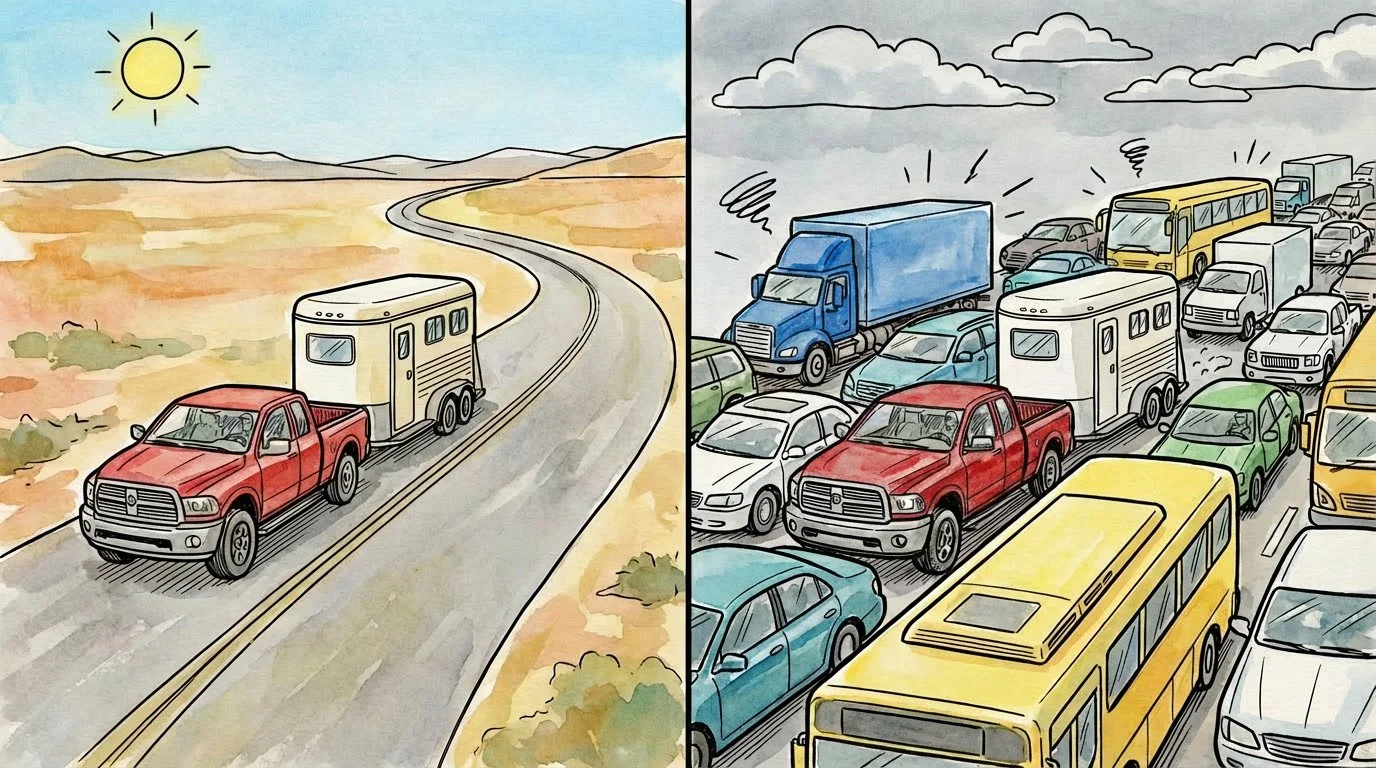
The difference between a safe departure and a dangerous delay is the 48-hour rule: by treating an 'Evacuation Warning' as an 'Order,' you can bypass the gridlock of community panic and ensure your horses reach safety before the roads become impassable.
When it comes to horses, an "Evacuation Warning" should be treated as an "Evacuation Order." The logistics of moving a herd are exponentially more complex than moving a family in an SUV.
Beat the Rush: Trailers are slow, bulky, and difficult to maneuver in panicked traffic. If there is even a 20% possibility of a disaster, evacuate.
Avoid the Gridlock: Waiting until a mandatory order means you will be fighting traffic, stalled cars, and panicked drivers. Getting your horses out 24–48 hours early is the kindest thing you can do for them.
8. The Community Hub: Infrastructure of Mutual Aid
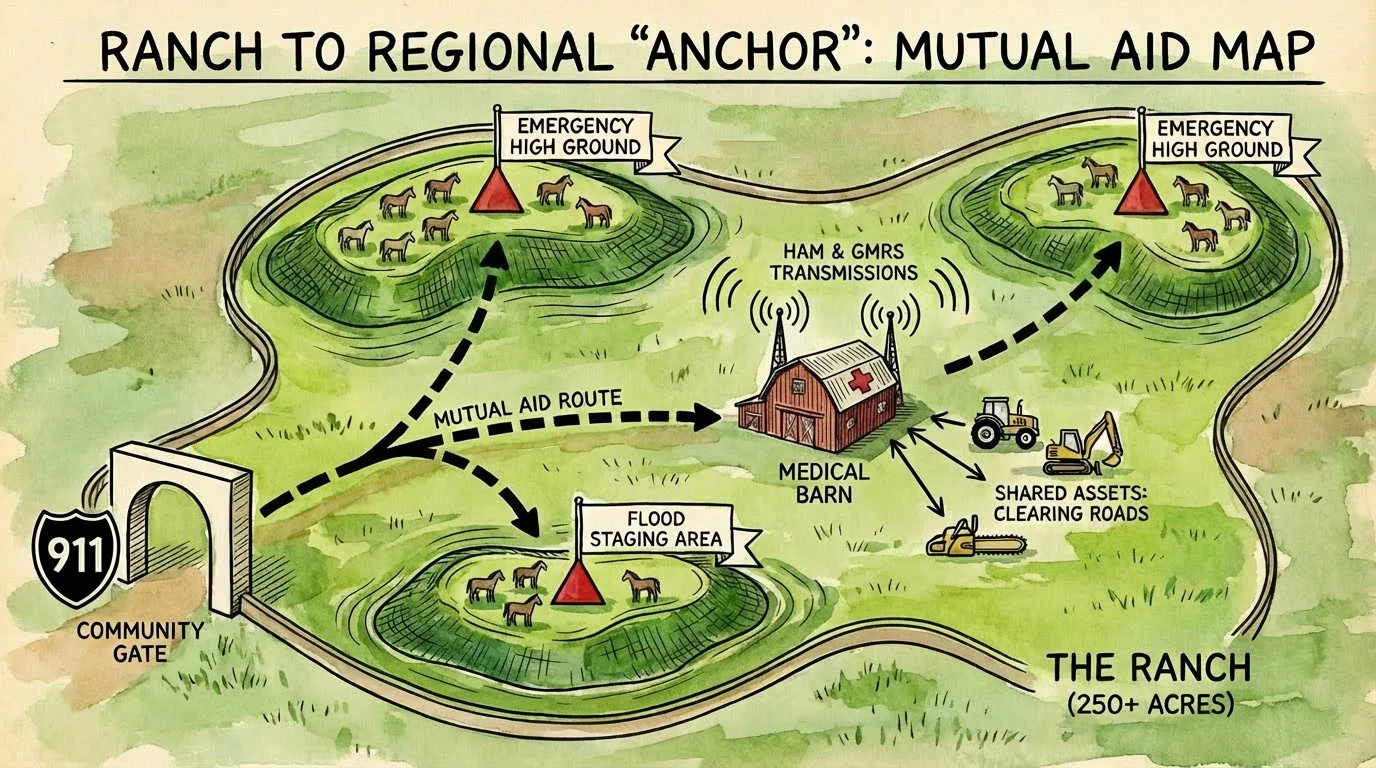
Resilience is a collective effort. Whether it’s a thriving business, a rescue, or a facility like Karma Ranch, large-scale properties have a unique responsibility to serve as community hubs—providing the critical infrastructure, high ground, and machinery that neighbors on smaller parcels need to weather a crisis.
This is where the 250+ acre stewardship model transforms from a private interest into a public asset. Large properties must be the "anchors" of their local equine community.
Staging and High Ground: Identify specific sectors of your property that remain dry during 100-year floods. Offer these as temporary staging areas for neighbors on low-lying "postage stamp" parcels who may not have time to evacuate to a regional fairground.
Communication Interoperability: Cell towers are often the first things to fail. Large estates should invest in GMRS or HAM radio setups to maintain contact with neighbors and local emergency services when the "bars" on the phone disappear.
Shared Assets & Heavy Machinery: A 250-acre property usually requires a fleet of tractors, backhoes, and industrial chainsaws. In a disaster, these are the tools of survival. Formalize a "Mutual Aid" agreement with your neighbors so they know who to call for road clearing or carcass removal.
The "Community Gate" Protocol: Designate a specific entrance for emergency use. Ensure local fire and rescue have the codes or keys. By being the "Hub," you ensure that first responders arrive at your property first, knowing it is the best place to set up a command post.
9. Water and Power Resilience: The Lifeblood of the Farm
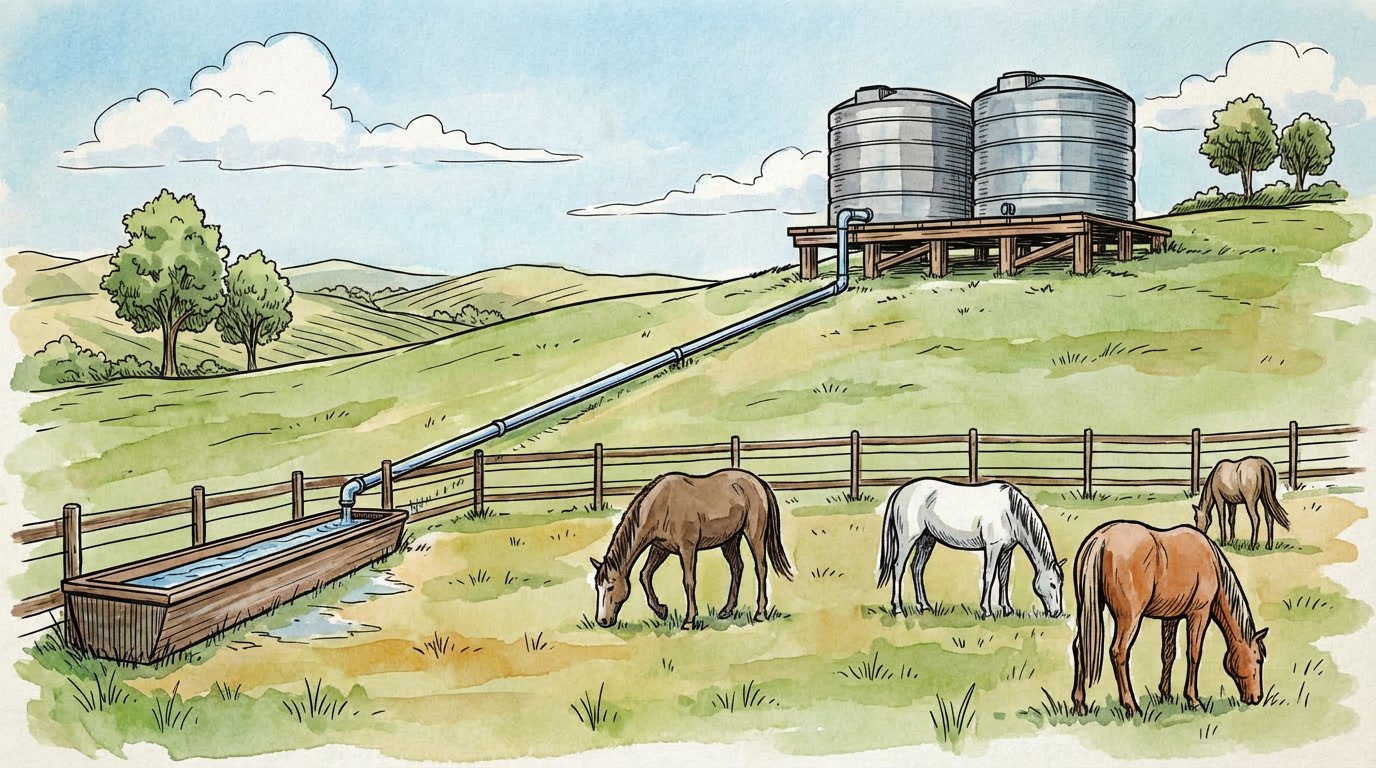
By leveraging natural topography or engineering your own elevated storage towers, you can establish a robust gravity-fed water system that bypasses the single point of failure inherent to grid-dependent well pumps.
On a large estate, the distance between the well and the horse can be a mile or more. When the grid goes down, the water stops.
Solar Well Backups: Investing in solar-powered pumps for at least one primary well ensures that you can provide water even during a long-term power outage.
Gravity-Fed Systems: If your topography allows, store water in tanks at the highest point of your acreage. In an emergency, gravity will do the work that electricity cannot.
The 72-Hour Water Reserve: Always maintain enough "static" water (tanks, troughs, or ponds) to last your entire herd for 72 hours without a single pump running.
The Future of Resilient Equine Stewardship

When infrastructure meets instinct. By integrating life-saving water towers and accessible medical hubs directly into the landscape, we ensure that our horses are protected by a system that works even when the grid fails, fulfilling our promise of long-term stewardship.
Preparing for the unexpected is a fundamental responsibility, but the strategies we choose define the safety of our herds for generations. True equine disaster preparedness is not a static checklist; it is a dynamic integration of land management, advanced technology, and rigorous training.
Whether you are navigating the complexities of a 250+ acre ranch or managing a dedicated family farm, the principles of scalability and redundancy remain the same. By shifting our perspective from a reactive "survival" mindset to a proactive "stewardship" model, we create environments where horses can thrive—even in the face of nature’s most challenging moments.
The core of this resilient model lies in understanding the biological reality of the horse. We must respect their "flight" instinct by providing the space and the freedom they need to survive. The strategy of "letting them loose" on high-ground pastures—or even opening the gates entirely in a flood emergency—is often the most compassionate and effective choice an owner can make. By removing the physical barriers of stalls and fences that can become traps during structural failures, we allow horses to utilize the survival skills they have honed over millennia.
Furthermore, we cannot overlook the human element. Training for chaos ensures that when the sirens blare, our horses look to us with trust rather than panic. This "muscle memory" is what allows for the early evacuation that saves lives. By moving 48 hours before the smoke reaches the fence line, we avoid the gridlock of community panic.
Ultimately, getting more people on board with the 250+ acre stewardship model is about more than just land ownership; it is about creating regional hubs of safety. These larger properties serve as the "anchor" for a community, providing heavy machinery, decentralized forage caches, and emergency medical redundancies to support neighbors in need. When we invest in larger tracts of land and better infrastructure, we aren't just protecting our own stable; we are building a more resilient, connected, and prepared equine community. By choosing to lead with foresight and scale, we ensure that the legacy of our horses remains secure, no matter what the horizon holds.
The Stewardship Toolkit: Ranch-Tested Gear
To help support the mission at Karma Ranch, we’ve curated a list of the exact gear we use to maintain our 250+ acre model. If you purchase through the links below, we may earn a small commission at no extra cost to you.
Thank you for being part of our community!
A blueprint is only as good as the tools used to build it. Below are the specific items that make our stewardship at Karma Ranch possible.

Equiderma Calendula Wound Ointment
Equiderma Calendula Wound Ointment is a premium, plant-based formula anchored by the calendula flower—a vibrant, orange daisy-like botanical long revered for its superior skin-mending properties. This ointment supports healthy tissue regeneration and helps prevent the formation of proud flesh by utilizing a deeply nourishing base of sunflower, olive, and jojoba oils, combined with shea butter, lanolin, and vitamin E. To use, simply cleanse the wound, gently remove loose scabs, and work the ointment into the surface contours 1–3 times daily. Its smooth consistency maintains skin flexibility to minimize long-term scarring, while lavender essential oil provides a soothing touch, making it an essential, gentle solution for maintaining skin wellness and comfort throughout your horse's natural recovery process.

Restoration Equine Mask
The Xpert Equine Restoration Mask is a dual-purpose powerhouse that we consider a "must-have" for both travel and trauma. Unlike traditional mesh fly masks, it features specialized amber plastic lenses that block 100% of blue light, allowing horses to produce the melatonin they need to relax and sleep in bright trailers or barns where lights stay on 24/7. This design makes it a game-changer for emergency eye injuries as well; the solid lens creates a protective barrier that keeps dirt and debris out far more effectively than mesh. We keep these on hand at all times—our own horse, Jupiter, wore one during her recovery of a deep facial wound right below her eye, and it stayed comfortable and secure. At a fraction of the cost of $200+ medical visors, it is an incredibly cost-efficient way to provide professional-level protection and stress relief.
CLICK HERE to add our favorite emergency mask to your equine first aid kit
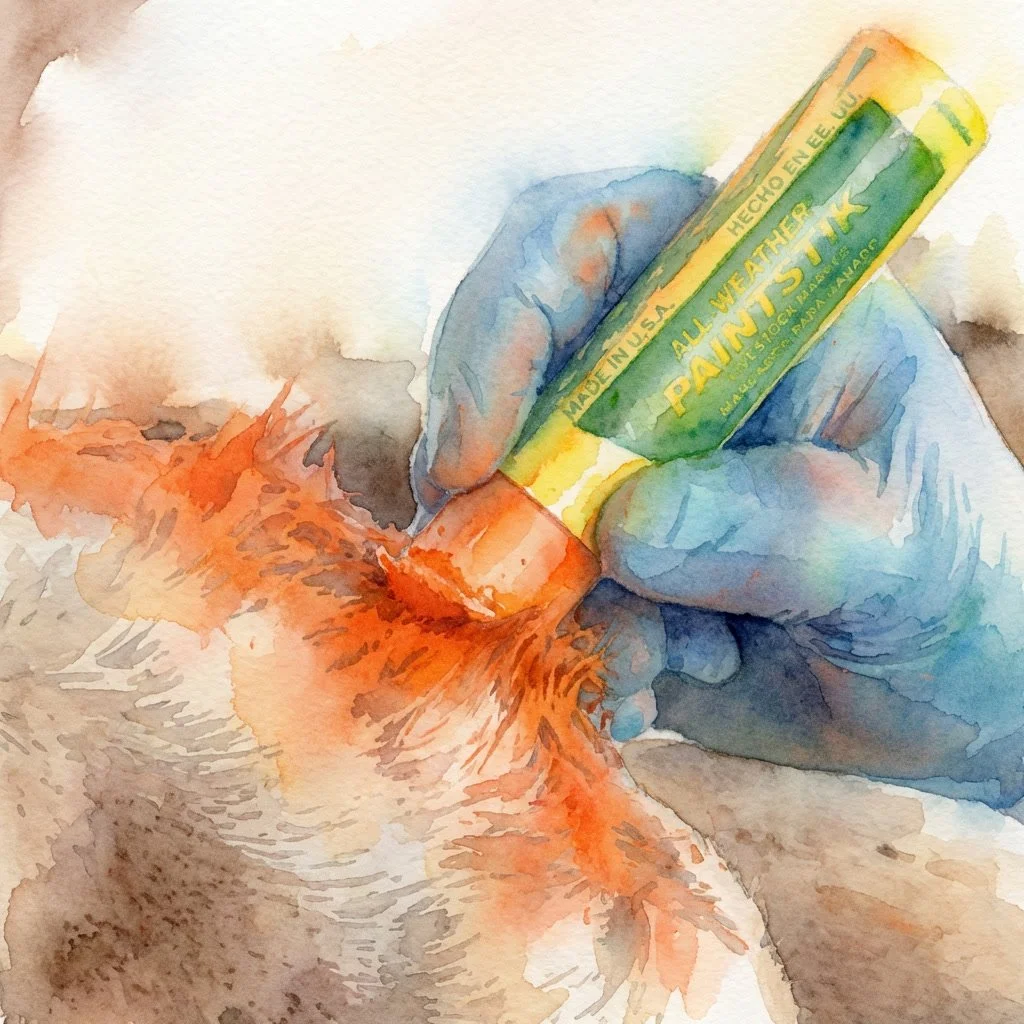
All-Weather Paintstik Livestock Marker
When disaster strikes and every second counts, the All-Weather Paintstik is an essential "analog" backup for your emergency kit. This highly visible, non-toxic livestock marker allows you to write your phone number directly onto your horse’s coat—or better yet, the number of an out-of-area contact who isn't affected by the local emergency. Whether the coat is wet or dry, this marker stays put through rain and wind, ensuring that if your horse is found, the rescuer has an immediate way to reach someone who can help. For us, it’s a non-negotiable part of our "go-bag"; in a rural area where cell towers might go down, having your contact info physically on the animal is the ultimate insurance policy for a safe reunion.

Medical Grade Manuka Honey Gauze Pads
Nature’s most powerful antibiotic meets high-performance wound care. Manuka honey is unique because it maintains a moist healing environment while its high sugar content and low pH naturally inhibit bacterial growth—essential for preventing infection in deep pasture cuts or abrasions.
We keep these gauze pads in every on-the-go kit at Karma Ranch because they don’t just protect the wound; they actively draw out fluids and debris, significantly speeding up the healing process for our horses without harsh chemicals.
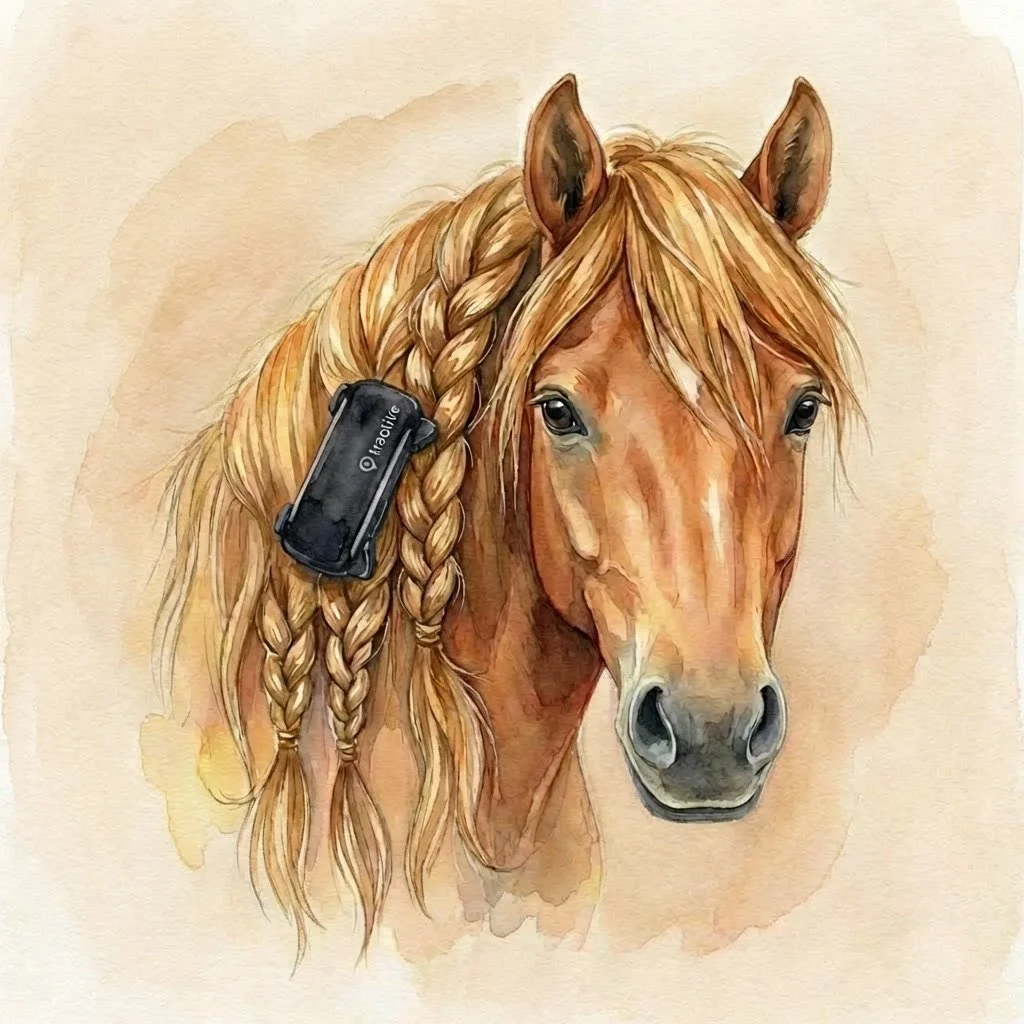
Tractive Smart GPS Tracker
When you’re managing 250+ acres in a rural area, standard Bluetooth trackers like AirTags are essentially useless once an animal wanders past the driveway. That is why we rely on the Tractive Smart GPS Tracker. Because it utilizes true satellite GPS and connects to multiple cellular networks, it provides unlimited range and real-time updates, no matter how deep into the "back forty" an animal roams. While originally designed for dogs, we consider these a non-negotiable part of our emergency kit for horses; in a disaster where fences might fail, and horses must be let loose, these can be securely braided into the mane or tail. This ensures that even in the chaos of an evacuation, you can locate your herd immediately via satellite. For a ranch our size, having a tracker that doesn't rely on a nearby phone signal is the only way to have true peace of mind.
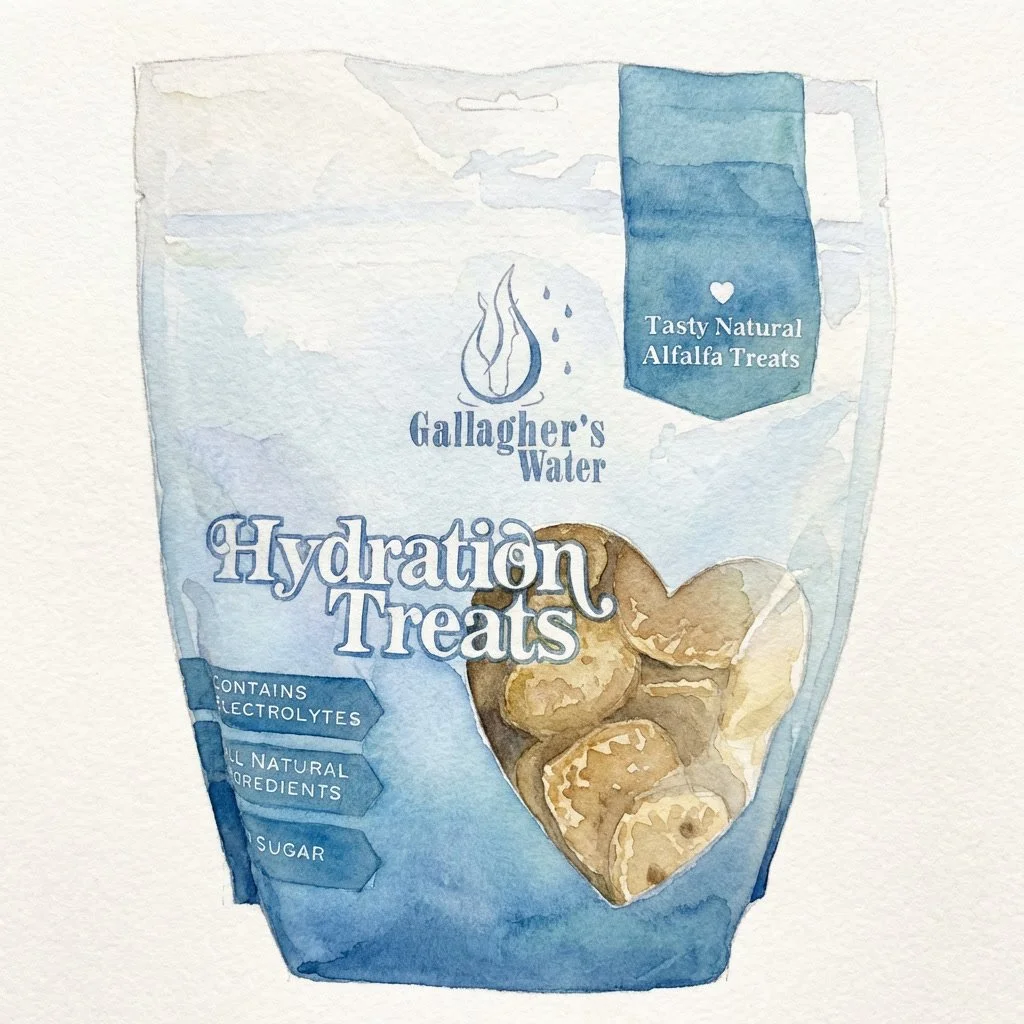
Gallagher’s Water Hydration Treats
Stress is the silent enemy of a healthy horse, especially during a crisis. We keep these heart-shaped, low-sugar hydration treats in our trailers, tack rooms, and emergency go-bags as a first line of defense against dehydration. Infused with the same electrolyte blend as Gallagher’s Water, these crunchy treats are an easy, 'on-the-go' way to encourage your horse to keep drinking when the environment gets tough. They are an essential tool for any steward looking to maintain equine gut health and peace of mind during transport or high-energy ranch work.
CLICK HERE to stock up on yummy emergency hydration treats for your horse

8-inch Mini Bolt Cutters
Size isn't everything when it comes to the Workpro Mini Bolt Cutters. We keep these on hand because their compact, 8-inch frame fits easily into a saddlebag or a pocket, yet they pack a serious punch for their size. While they aren't meant for heavy-duty structural steel, they are perfect for cutting through wire, cables, or stubborn hardware in a pinch. We’ve personally put these to the test on our property—and while we may have pushed them past their limit once or twice on projects far bigger than they were intended for, their portability is what makes them indispensable. In an emergency, having a tool that is actually with you is worth more than a heavy-duty one sitting back at the barn.
Items We Stand By
These are the essentials we trust to keep our horses healthy at Karma Ranch Horse Sanctuary. Whether you choose to support Karma Ranch by purchasing through the links above—which gives a little back to our mission—or you prefer to buy directly from the brands, our goal remains the same: sharing what works.
We believe these are truly essential items that will strengthen any first-aid kit and provide the best care possible for your horses.