The Auction Block and the Final Hour: Understanding the Equine Rescue Pipeline

In the world of horse welfare, there is often a heated, polarizing debate over the allocation of energy and limited resources. It is a conversation that frequently divides many well-meaning advocates: Should we "bail" horses from the brink of death in kill pens, or should we focus efforts solely on intervening at local auctions before the damage is done?
This question isn't just about logistics; it’s about where the line is drawn in the sand when a life is in danger. At Karma Ranch, we believe that when a soul is at stake, the answer isn’t "either/or"—it is "whatever it takes." We believe there is a vital, non-negotiable place for both methods, as well as for the critical direct field interventions that occur in backyards and back pastures before a horse ever reaches a trailer. While the industry debates the "best" way to save a life, Karma Ranch chooses to focus on the horse standing in front of us, regardless of how they got there or what label the system has placed upon them.
The Reality of the "Loose Horse"
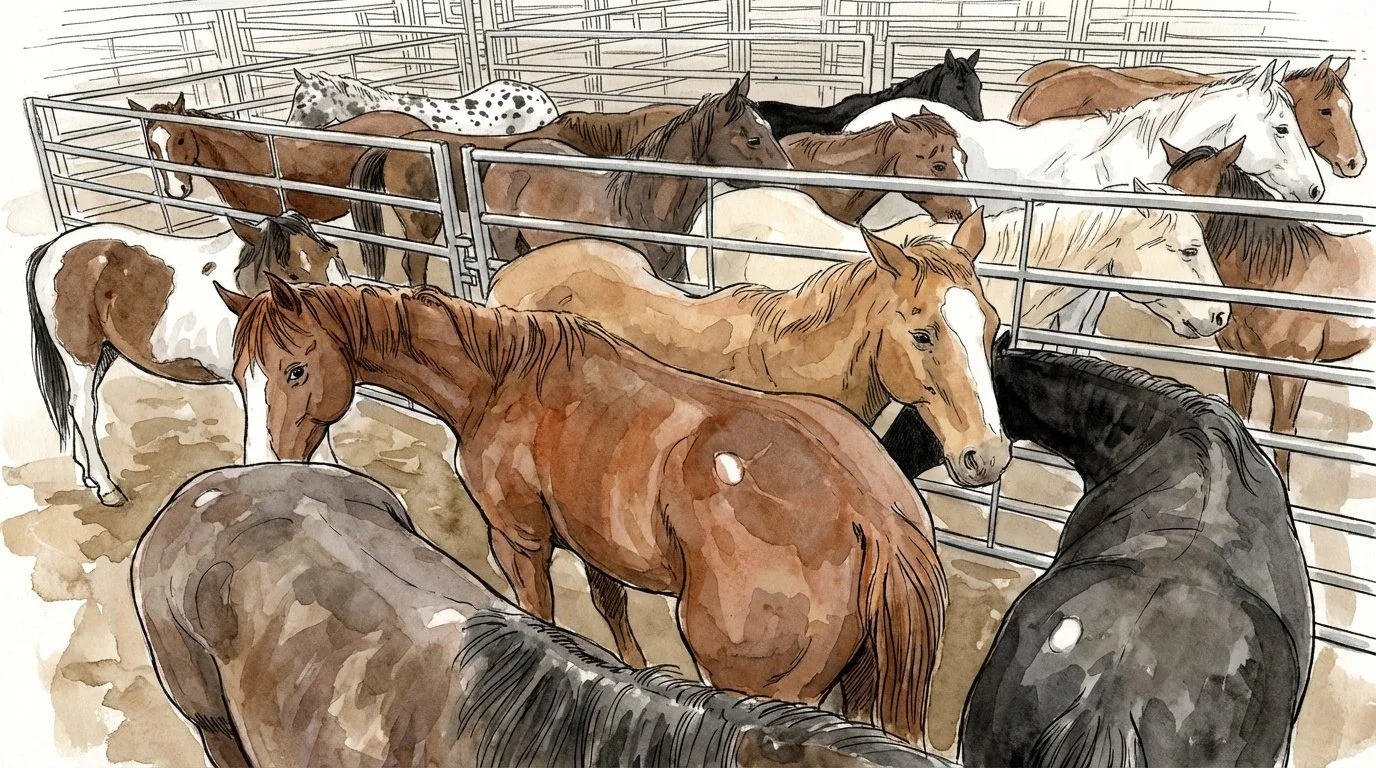
At local auctions across the country—the kind held in dusty arenas on Friday nights or early Saturday mornings—there is a category known as "loose horses." These are the forgotten souls of the equine world, often viewed as nothing more than livestock inventory. They are called "loose" because they are frequently run through the ring without a rider or a halter, sometimes in groups, to be sold as quickly as possible. To the observer, they are a blur of movement; to the trader, they are a price per pound.
These horses are dropped off by owners who, for various reasons, simply want to be rid of them for any price. To the seller, the horse has lost its utility or financial value; to the "loose" category, the horse has lost its identity. These horses are a heartbreaking mix of:
Seniors: The "old reliables" who gave their best years to a family, a farm, or a lesson program, only to be discarded when they can no longer be ridden. They stand in the pens with graying muzzles, confused as to why the hands they trusted have disappeared.
Medical Cases: Horses suffering from chronic conditions, untreated injuries, or severe malnutrition. Instead of receiving the veterinary care they deserve or the dignity of a peaceful end, they are "dumped" at auction to avoid the cost of treatment or euthanasia.
"Behavioral" Horses: These are often the most misunderstood. Many are simply scared, poorly started, or reacting to past trauma. In the high-stress, high-noise environment of an auction, their fear is mislabeled as "dangerous" or "unfixable," making them even less likely to find a private home.
In these "loose" pens, there is often no "bottom bid." There is no reserve price to protect the horse’s life. If no family or independent buyer steps up to offer a few hundred dollars, these horses are sold for pennies on the pound. They are bought by the truckload by horse traders, also known as kill buyers, who see them not as sentient beings, but as a weight-based profit margin.
The Long Road to the Kill Pen: The Hidden Exhaustion
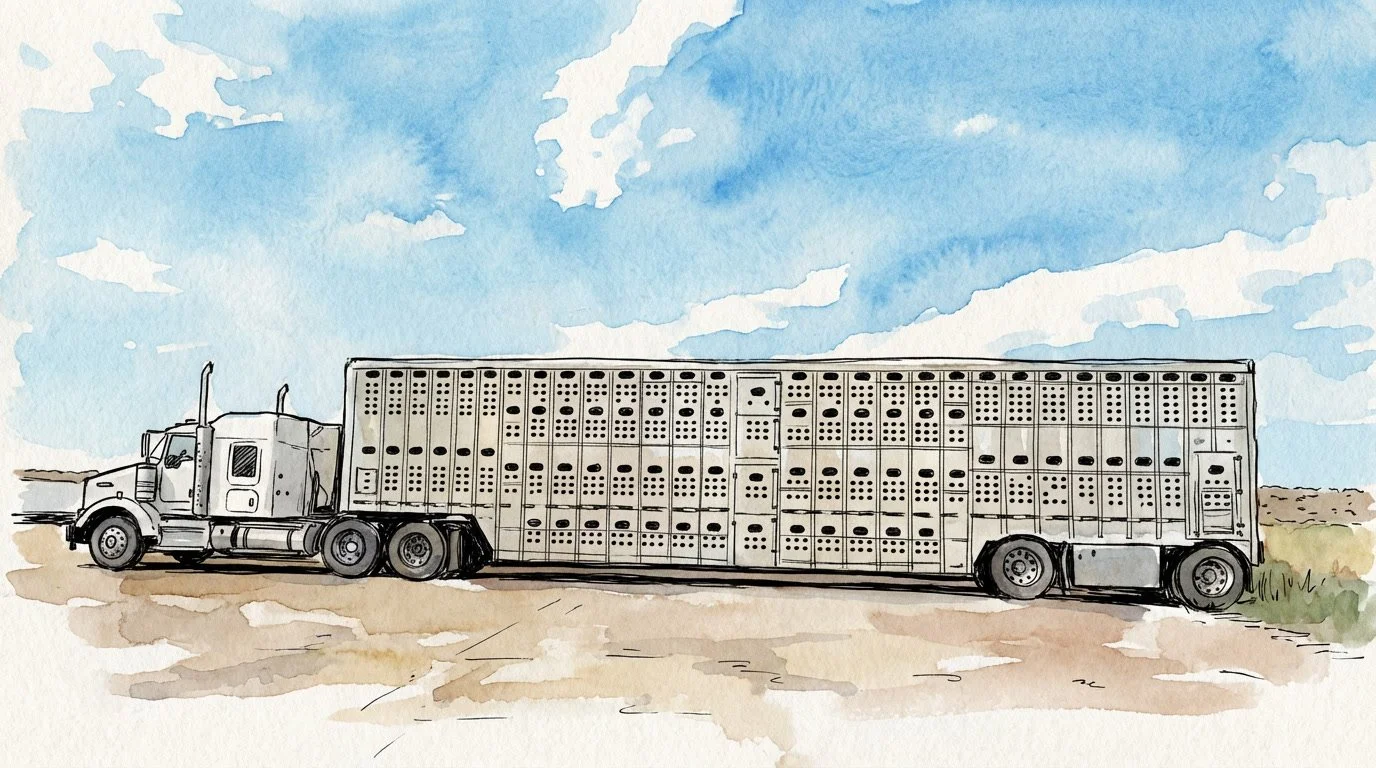
When the gavel falls, and a horse is loaded onto a trader’s trailer at a local auction, they haven't just changed owners—they have officially entered the slaughter pipeline. This is not a quick or direct journey. It is a grueling, weeks-long process of "warehousing" and transport that strips a horse of their dignity, their spirit, and their health.
Most people do not realize that horses ending up at major, well-known kill pens—like the one in Bowie, Texas—did not start their journey there. They have often been "flipped" or shuffled through a cycle of five, six, or even eight different local auctions across multiple states. The traders move them from one sale to the next, hoping to squeeze out a few extra dollars of profit or simply waiting for a full load to ship across the border. For the horse, this means:

Constant, Relentless Stress: Being loaded and unloaded from cramped, dark trailers dozens of times in a matter of weeks.
Biosecurity Risks: Exposure to "shipping fever," strangles, and other respiratory illnesses from being co-mingled with hundreds of other stressed, sick animals in unsanitary holding pens.
Physical Deterioration: Living on minimal food and water while standing on hard trailers or in muddy, overcrowded lots.
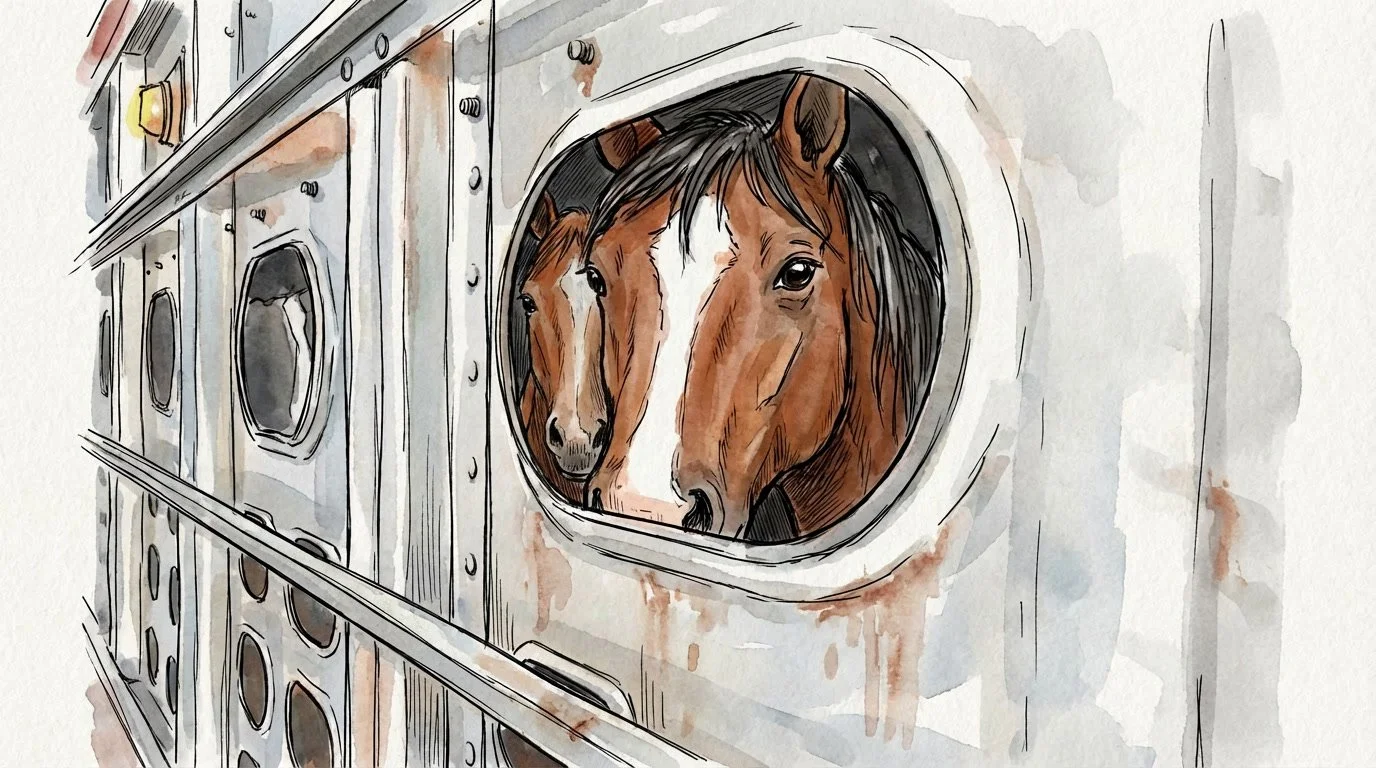
By the time a horse reaches that final destination, they are no longer the horse they were at the first auction. They are exhausted, often malnourished, and emotionally "shut down" from the trauma of the road. They have reached their absolute last resort. They aren't "bad" horses; they are simply horses that have been broken by a system that views them as a commodity rather than a living, breathing soul.
Four Paths, One Goal: The Karma Ranch Perspective

Karma Ranch has seen the value of intervening at every stage of this pipeline. Each path requires a different kind of strength and a different strategy, but they all lead to the same destination: safety, healing, and dignity.
The Kill Pen Rescue: Interception at the Finish Line
Rescuing from a kill pen is a literal act of life-saving at the final hour. Jupiter, the Founding Horse of Karma Ranch, is the living embodiment of why this path matters. She was standing in a kill pen, pregnant and exhausted; had she not been pulled from that finish line, she would have been loaded onto a ship-to-slaughter truck. Her baby, Kale, would never have been born. We must never judge those who pull horses from these pens. Every life saved is a victory, and a horse is no less deserving of a future just because they were forced to wait until the very last second for someone to see their worth.
The Local Auction Intervention: Stopping the Cycle
There are incredible rescues that spend their time at local auctions, standing right there in the stands to outbid the traders. By doing this, they prevent the trauma from compounding. They prevent the horse from having to endure the "5, 6, or 7" different auctions and the weeks of transport that lead to the final kill pen. This is an essential "mid-stream" intervention that saves the horse from the most grueling part of the pipeline.
The Direct Field Intervention: Upstream Rescue
Then there is the path taken with horses like Luna. She was found in a dire situation and rescued before she ever set foot on an auction trailer. This is "upstream" rescue—finding the animals that are suffering in silence in back pastures or neglectful homes. By stepping in here, Karma Ranch ensures the horse never has to experience the "loose horse" pen or become a trader's statistic in the first place.
The Open Door: Proactive Owner Surrenders
Finally, there is the most proactive path of all: Owner Surrender and Open Door policies. Karma Ranch works tirelessly to provide a safe alternative for owners who can no longer care for their horses due to financial hardship, health issues, or life changes. By offering a "safety net," we give owners a way to bypass the auction system entirely. An open-door policy ensures that a horse goes directly from one home to a sanctuary or a vetted new family, completely removing the risk of them ever entering the slaughter pipeline. This is where the cycle is broken for good.
Beyond the Bail: Building a Sustainable Safety Net
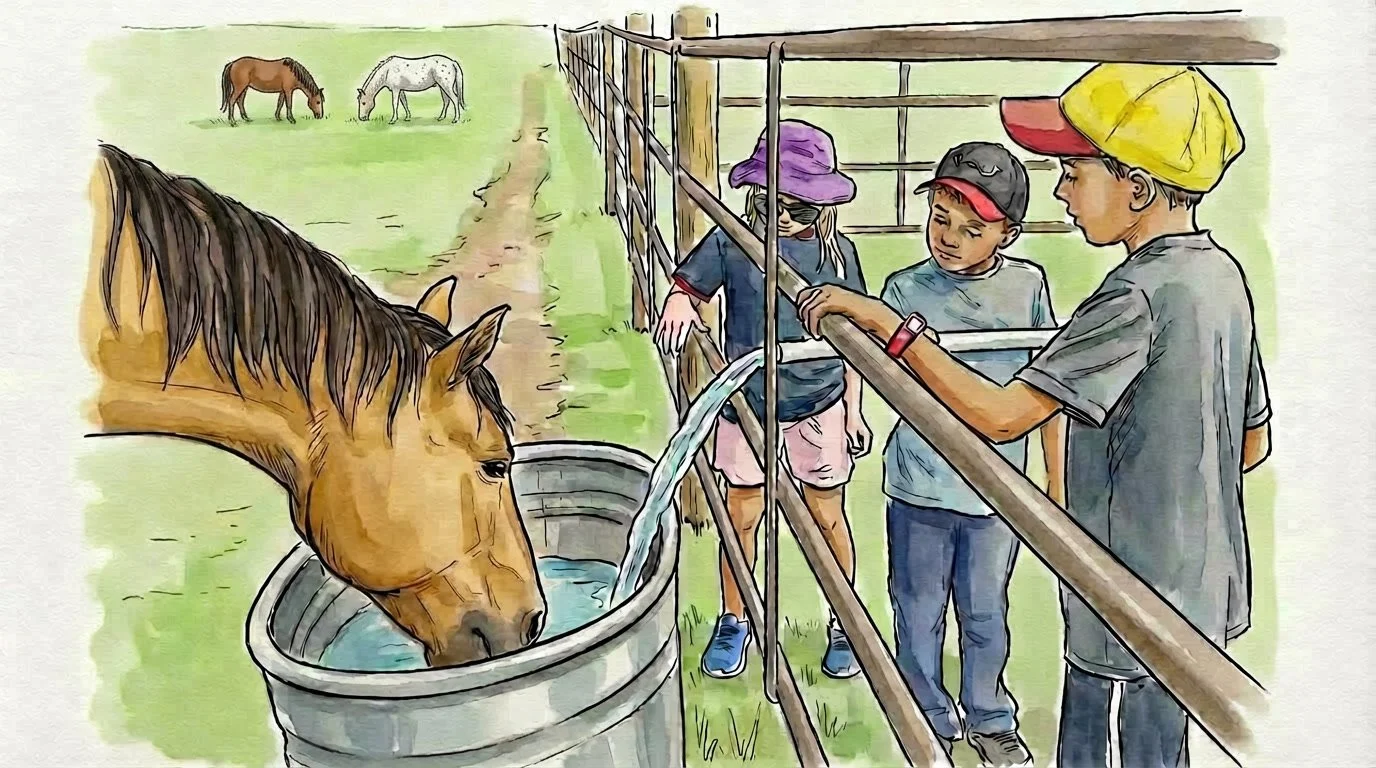
While the four paths are all necessary for rescue, we believe that the ultimate goal of any sanctuary should be to move further 'upstream.' This is why we are shifting our focus toward building a sustainable safety net.
While we deeply understand the emotional drive to rescue a horse directly from a kill pen—and have experienced the profound reward of doing so—we want to be clear: bailing horses from the slaughter pipeline should be a last resort, not a primary strategy. For a rescue or sanctuary to be truly sustainable and impactful, we advocate for a "Prevention First" model.
This means:
Intercepting at Local Auctions: Stopping the Trauma Before it Starts
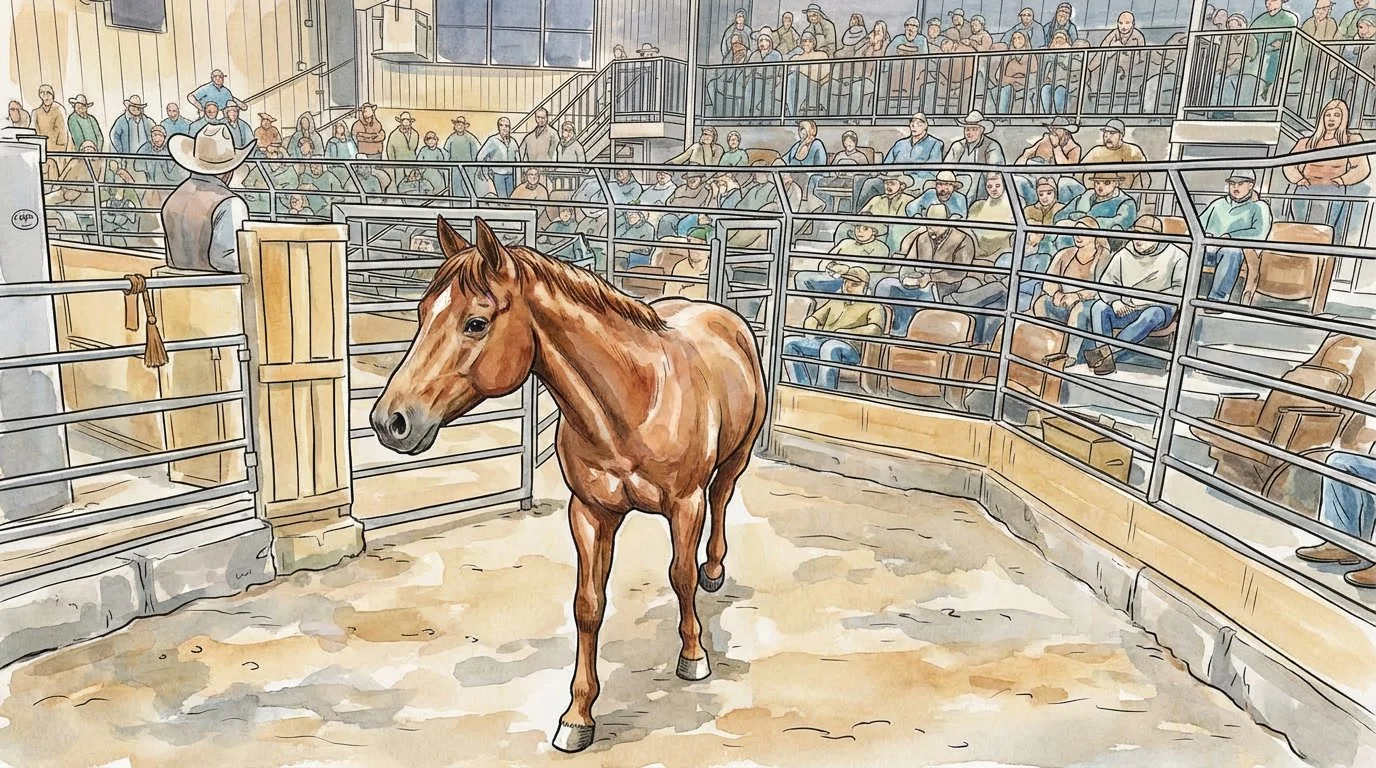
By purchasing horses at local general auctions before they are outbid by kill buyers, we effectively close the door on the slaughter pipeline before the horse even steps through it. There is a common misconception that a horse goes straight from an auction to a final destination, but the reality is much more grueling. Interceding at the local level prevents the animal from ever entering the biohazard environment of the trader's holding pens.
When a horse is bought by a kill buyer, they are often "warehoused" in overcrowded, unsanitary lots where they are exposed to highly contagious diseases like Strangles, Shipping Fever, and various respiratory infections. For a stressed horse with a compromised immune system, these pens are a death trap. By outbidding the traders at the local auction, we save the horse from this unnecessary physical and psychological trauma.
From a sanctuary’s perspective, this is also a matter of stewardship and safety. A horse pulled from a kill pen requires weeks, sometimes months, of strict quarantine and often thousands of dollars in emergency medical interventions just to stabilize their health. By intercepting at the auction, we bring home a horse that is far less likely to be a "biosecurity risk" to our resident herd. This allows us to focus our resources on long-term rehabilitation and training rather than emergency crisis management, making every donor dollar work harder for the horse’s actual future.
The Power of the Owner Surrender: Breaking the Cycle at the Source
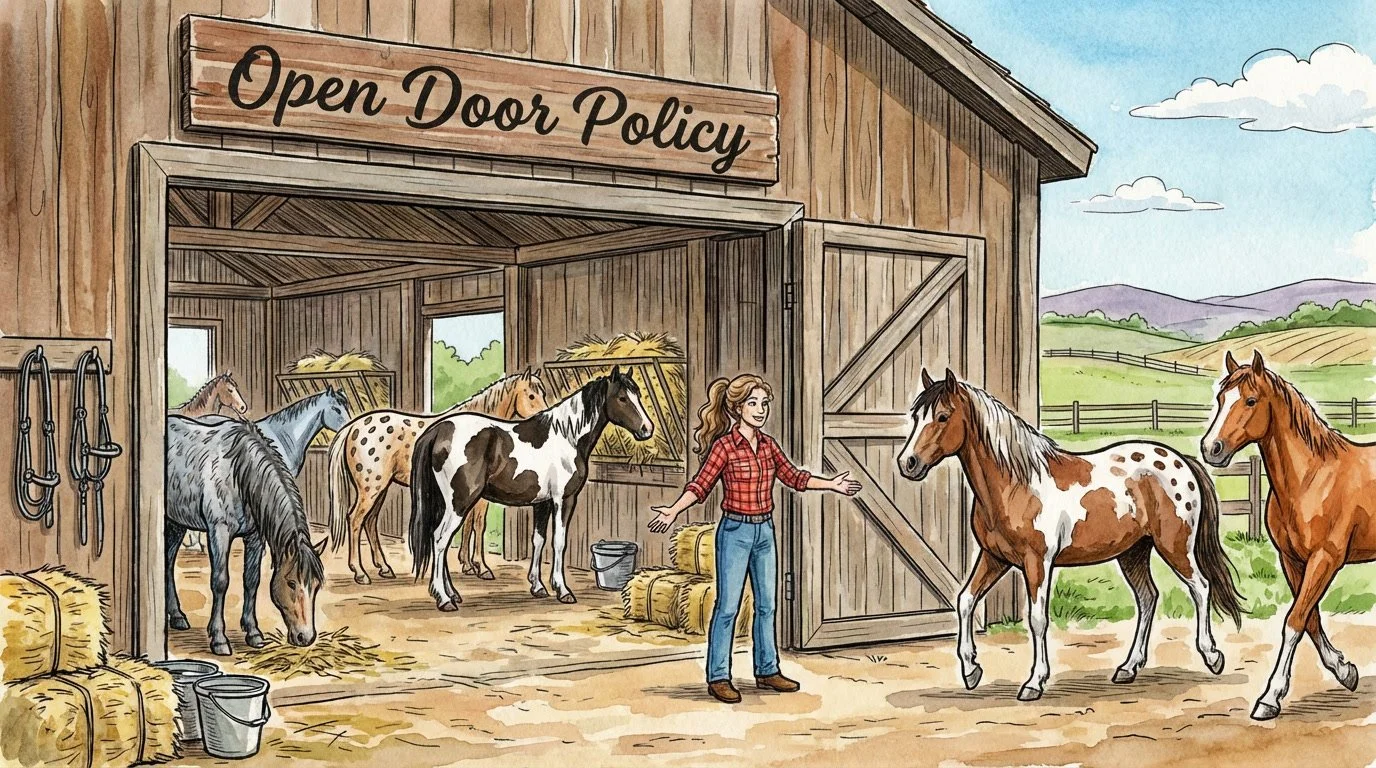
Opening doors to owners who can no longer care for their animals is the most effective way to starve the slaughter pipeline. For many owners, the decision to surrender isn't made out of a lack of love, but out of a desperate lack of options. By providing a safe, non-judgmental landing "upstream," we ensure that a horse never has to experience the confusion and fear of the auction system.
There is a mechanical advantage to this method: Catching a horse at home—where they are still healthy, fed, and handled—allows donor dollars to go three times as far. When we pull a horse from a kill pen, the "bail" is only the beginning. We are often immediately met with thousands of dollars in emergency costs: treating "shipping fever," addressing severe malnutrition, and managing the long-term psychological trauma of the pipeline. In contrast, a horse surrendered directly from a home arrives with their health and spirit intact. Instead of spending months on "damage control" and quarantine, donor funds can be used immediately for high-quality forage, specialized training, and long-term sanctuary infrastructure.
By removing the "middlemen" of the auction and the trader, we aren't just saving a life—we are preserving the horse's health and the community's resources. This "safety net" ensures that a transition in ownership doesn't have to mean a descent into the pipeline.
Dignity Through Euthanasia Assistance: The Final Act of Stewardship

One of the kindest, most overlooked forms of rescue is providing financial assistance for humane euthanasia. For an owner in crisis—perhaps facing a sudden job loss, medical emergency, or the age-related decline of a lifelong companion—the "free" drop-off at a local auction often feels like the only viable exit strategy.
But there is no such thing as a "free" exit. When an owner takes an elderly, sick, or injured horse to a local auction, they are stepping into a trap. While they may hope a kind soul will see their horse’s worth, the reality is that these horses often receive zero bids from the general public. In that silence, the "meat man" or kill buyer steps in. Because no one else is bidding, they are able to buy a senior or suffering horse for pennies on the pound—sometimes for as little as $50. The owner walks away thinking the horse found a "home," but in reality, that horse has just been bought by a trader to be shuffled through the pipeline.
This happens because a responsible, peaceful end is expensive. Between veterinary fees and burial or cremation costs, a dignified end can easily cost an owner $600 to $1,200. When a neighbor cannot bridge that gap, the trader’s trailer becomes the default. By providing euthanasia assistance, we ensure a horse never has to stand in that "no-bid" auction ring or experience the "rot" of the pipeline. This is "upstream" rescue at its most profound: protecting a soul from a traumatic ending by funding the "last mile" of their journey. By providing euthanasia assistance, a sanctuary does more than just offer a service—it actively starves the slaughter pipeline of its victims. It ensures that a horse’s story ends in a familiar pasture rather than a chaotic auction ring, while offering the owner the grace of a goodbye without the shadow of guilt.
A Legacy of Mercy, A Future of Prevention

While we advocate for these proactive measures, we want to be clear: we do not believe that rescuing a horse from a kill pen is "wrong." In fact, it is a part of our own DNA. Karma Ranch would not exist as it does today without the "final hour" rescue. Our founding mare, Jupiter, was standing in a kill pen, pregnant and exhausted, when we reached her. Had we not intervened at that finish line, she would have been lost, and her foal, Baby Kale, would never have known the feeling of sun on his back or the safety of a herd.
We will always honor the rescuers who stand in the gap at those pens. However, we also recognize that the strongest, most sustainable impact happens when we meet the horse where they are. Especially for a rescue or sanctuary not located near a major kill pen, the most effective use of resources is to catch the horse before the damage is done.
“We don't discard the horses currently in the pens, but we believe that the strongest rescues are the ones building a wall around their own community—intercepting at local auctions, supporting neighbors in crisis, and opening their doors to surrenders—so that no local horse ever has to cross that line in the first place.”
Every Horse Deserves a Voice: The Unchanging Worth of a Soul

Whether a rescue focuses on pulling horses from the brink at a kill pen, outbidding traders at a local auction, or intercepting a crisis at a private home, the heart of the mission remains identical. We are not just "buying animals"; we are reclaiming lives.
A horse’s worth is not defined by the person who owned them last, the trader who bought them for meat prices, or the location of the pen they were standing in when they were saved. A horse is not "trash" just because they were labeled as a "loose horse," and they are not "worthless" just because they ended up in a pipeline. Their value is inherent, born into them the moment they took their first breath.
At Karma Ranch, we honor the unique and often harrowing journey of every horse that crosses our path:
• We honor the survivors like Jupiter, who endured the absolute worst of the system and came out the other side with a life to give.
• We honor the "intercepted" souls like Luna, who were spared the trauma of the pipeline because the mission reached them before the world tried to throw them away.
Whether they were snatched from the final hour or protected from the pipeline entirely, they are all the same: they are sentient beings with a right to peace, a right to grass under their hooves, and a right to a name that isn't a slaughterhouse number. At the end of the day, Karma Ranch isn't just saving horses; we are giving a voice back to those the world tried to silence.
The Ethics of Interception: A Lesson from History
Trigger Warning: The following section discusses sensitive topics, including slavery, war, and the exploitation of living beings. These are dark parts of our shared history, but they are necessary to understand the gravity of the choices we face in rescue today.
Note on Ethics and Historical Examples
The historical examples in this section are included to illustrate a specific philosophical point: when legal systems fail to protect sentient beings, moral courage often requires crossing the "lines written in the sand" to save a life.
While some may find these comparisons uncomfortable, the discomfort often stems from speciesism-the belief that the suffering of an animal is inherently incomparable to that of a human. At Karma Ranch, we operate from the baseline that horses are sentient, living creatures that experience fear and pain. To acknowledge the systemic cruelty they face is not to diminish human history, but to challenge the logic that treats any living being as a disposable tool. Sometimes, the only way to save a life in front of you is to step outside of a broken system —a reality that many rescuers face every day when choosing to intervene in the slaughter pipeline.
To those who argue that rescuing a horse from a kill pen is "unethical" because it puts money into the pockets of traders, Karma Ranch invites you to look at the history of both human and animal rights. Throughout time, when systems have been cruel and laws have been unjust, the most compassionate people in the world have been forced into a heartbreaking corner: they have had to "buy" lives from the hands of criminals to prevent a total and final loss.
The "Freedom Funds"
The Abolitionists
In the centuries-long fight against slavery, many brave individuals and groups raised what they called "freedom funds." These funds were used to "purchase" the liberty of enslaved people, specifically to keep families together or save individuals from being sold "downriver" to even more brutal conditions. The abolitionists detested the system of slavery with every fiber of their being, yet they recognized a fundamental truth: a soul in chains cannot wait for a decades-long political shift. They bought the person to break the chain.
In the 1830s, the New York Committee of Vigilance, led by David Ruggles, faced this exact dilemma. While they fought for the total legal abolition of slavery, their 1837 records show they also raised $840 to pay the "recovery fees" and legal ransoms required to snatch individuals back from Southern slave traders. They didn't view this as supporting the market; they viewed it as the only way to save a life that the law had already failed to protect.
To a modern reader, $840 might sound like a small donation, but in 1837, it was the equivalent of nearly $29,000—a massive, community-funded war chest used to pull people out of traffickers' hands. They understood that while the system was the enemy, the individual standing before them was the priority.
(Source: Zinn Education Project)
The Weight of a Bribe
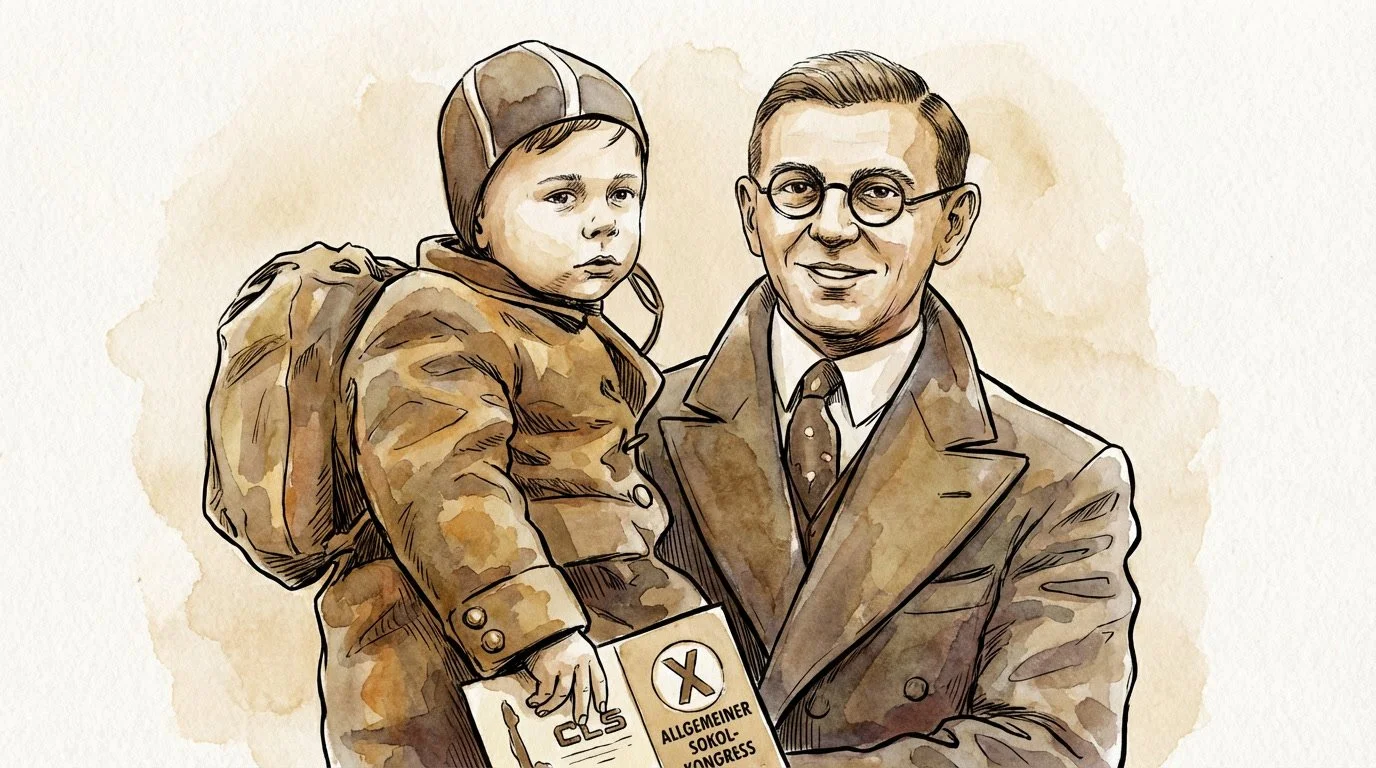
During the Holocaust, Sir Nicholas Winton didn't have the luxury of waiting for the regime to fall. He paid "fees," guarantees, and direct bribes to a murderous Nazi government to buy the only thing that mattered: time and lives. He knew the money was going to an evil system, but they also knew that every pound or mark spent was a child or a worker who would live to see the next sunrise.
They didn't fund the problem; they rescued its victims.
The Modern Ransom
The Dog Meat Trade
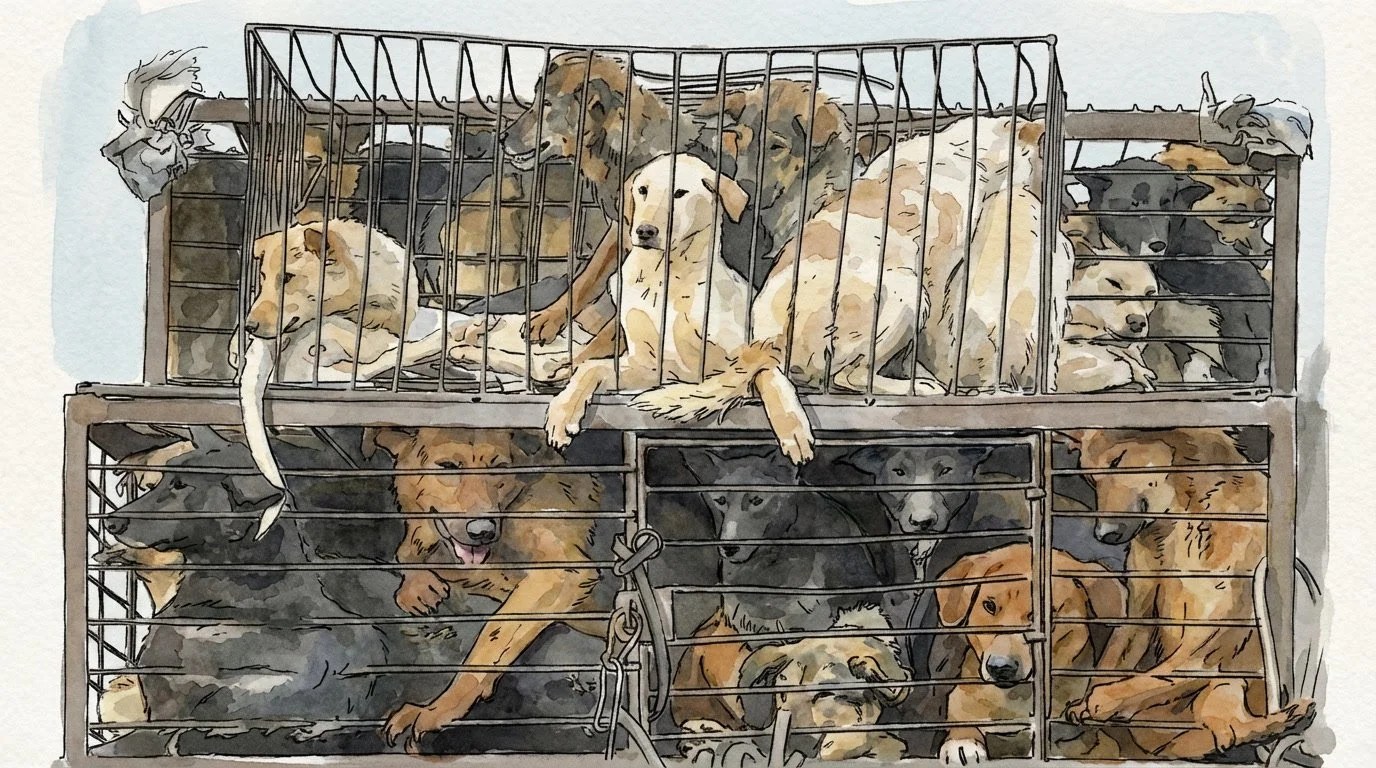
We see this exact same moral dilemma today in the fight against the dog meat industry. There are multiple international rescues that go directly into these meat markets and pay the butchers and breeders to release the dogs to safety. We know these breeders are part of a horrific cycle—they may very well turn around and use that money to breed more dogs, just as a kill buyer might buy more horses. Yet, we rarely see people condoning or attacking these dog rescues. Why? Because we recognize that for the dogs currently in the cages, there is no other way out. We pay the very people we despise because the life of the dog is worth more than the principle of the "market."
The Ransom of the Wild
Wildlife Conservationists
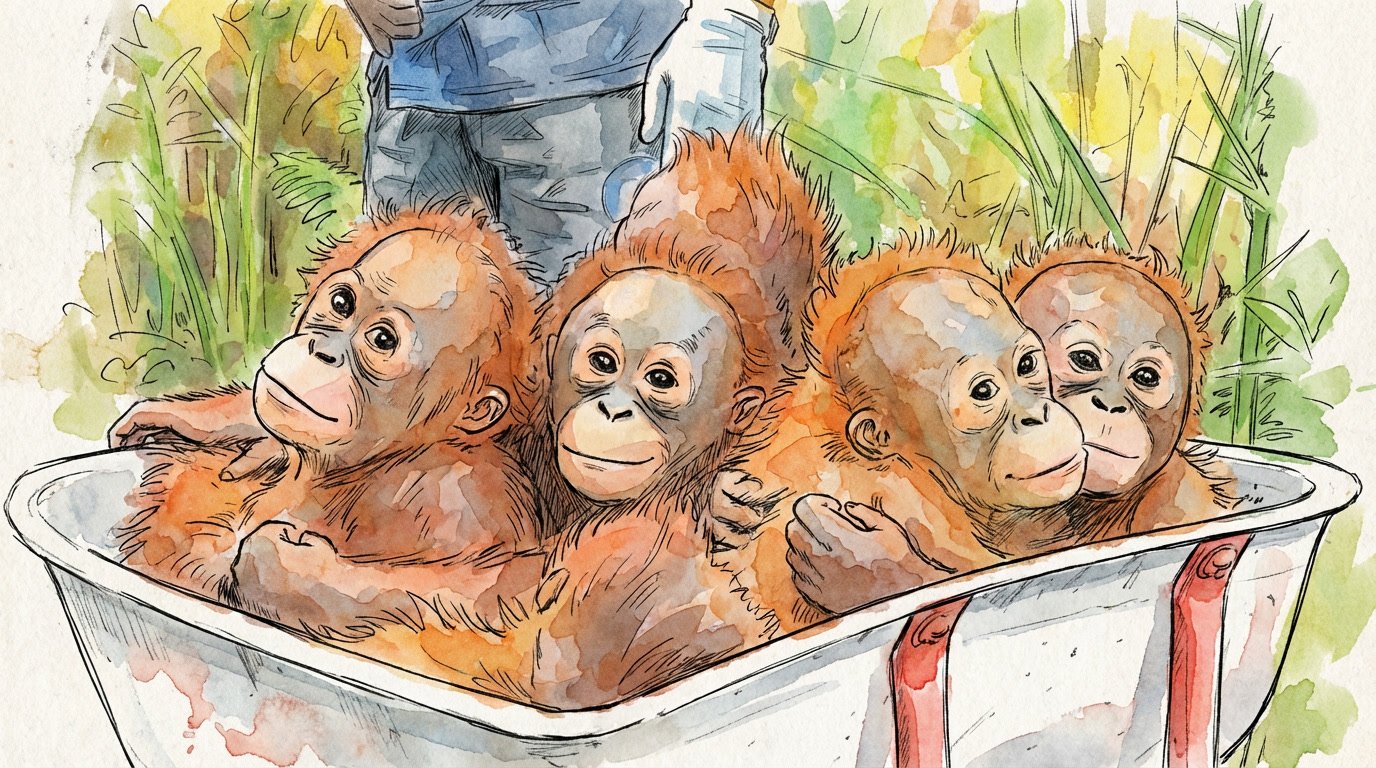
Even today, in the darkest corners of the black market, conservationists face a grim reality. They often have to pay local poachers or illegal traffickers to release endangered species—like Hammerhead sharks caught in nets or Orangutans stolen from the rainforest—back into the wild or into sanctuaries. They know the market is evil. They know the poacher shouldn't be rewarded. But for the animal gasping for air or crying in a crate, "waiting for the market to collapse" is a death sentence. To save the species, they sometimes have to pay the enemy.
While we recognize that the scale of human tragedy in these examples is incomparable, the moral burden placed on the rescuer remains the same: the agonizing choice to either fund a corrupt system or watch an innocent life perish.
Was it "wrong" to pay those systems? Did those payments "fund the problem," or did they provide the only exit ramp for a soul that would have otherwise been destroyed? When a horse is standing in a kill pen like the one in Bowie, Texas, they are not a political statement. They are not an economic theory. They are a living, breathing being that is running out of time. Rescuing from a kill pen doesn't mean we support the system—it means we refuse to let the individual pay the ultimate price while the rest of the world waits for the system to change.
The Price of a Soul: Why We Won’t Look Away
At Karma Ranch, and for so many in this community, this isn't just about animal husbandry—it’s about a deep, spiritual recognition. We believe that horses possess a soul every bit as vibrant and complex as a human’s. They are sentient beings who experience the sharp sting of pain, the cold weight of fear, and the profound capacity for love and loyalty just as we do. When you see a horse through that lens, they stop being "livestock" and starts being "someone." And when "someone" is in danger, there is no length we won't go to and no fire we won't walk through to bring them home.
Yes, that sometimes means making the agonizing choice to pay a kill pen "bail" to get a horse to safety. We know the arguments. We know the economics. But we also know the individual.
If you have read this and still disagree with this method, Karma Ranch respects your perspective. Ethics are personal, and the horse-welfare world is big enough to accommodate different approaches. We truly encourage you to find and pour your support into local rescues that focus strictly on auction interventions or owner surrenders. Their work is vital.
However, we ask one thing: do not judge or condemn those who are in the trenches saving lives at the finish line. The haunting reality is that we cannot sleep at night knowing a horse is standing in a crowded pen, shivering in the dark, waiting for a trailer that leads to a slaughterhouse. We hear their silence. We feel their fear. Because we carry that burden, we will endure any judgment, navigate any "black market," and pay any price to ensure they land softly.
Whether we are intercepting a crisis in a field, outbidding a trader at a local auction, or pulling a pregnant mare from the final hour, the mission remains unchanged. At Karma Ranch, we believe that no soul is "too far gone" and no life is a "waste of resources." Every single one of them is worth the price of the exit.
A Call to Action for Change
Our final advice to the community is this: if you feel that the mechanics of kill pens are shady or unethical, the most powerful thing you can do is take action. Find a local rescue that specializes in intercepting horses at the source, or better yet, become a fierce advocate for the law. Start calling your local senators and politicians to demand real, systemic change.
We must realize that until the legal classification of horses changes and they are no longer viewed simply as "livestock," there will continue to be zero consequences for those who drop off neglected, abused, and malnourished horses at auctions. As it stands, the law allows owners to abandon their responsibilities at the auction gate with total impunity. These are the very animals that end up in the "loose pens," falling victim to kill buyers and traders because the system failed to protect them long before they reached the ring.
Until the laws in America change to reflect the sentience of these animals, kill pens will continue to exist as a byproduct of a broken system. In the meantime, there are so many of us who simply cannot stand by and watch a horse be sent to slaughter just because a trader owns them and is demanding a ransom. We refuse to let a horse pay the ultimate price just because their "bail" is higher than their original auction value. Until that dark path is closed for good, we will continue to intercept these souls wherever they stand—because no horse deserves to be lost to a pipeline that should never have existed in the first place.
The Mission is Big Enough for Every Path
At Karma Ranch, we aren't here to tell you that our way is the only way. The crisis of horse welfare in America is a massive, multi-headed beast, and it takes an army of different strategies to fight it. While we will always stand in the gap at the finish line for horses like Jupiter, we have immense respect for the organizations that choose to draw their line at the auction gate or the pasture fence.
If you believe that resources are better spent preventing horses from ever reaching a kill pen, we encourage you to follow and fund these incredible organizations. Their work is vital, their hearts are in the right place, and they are moving the needle every single day. Whether you support the "finish line" rescue or the "upstream" intervention, the goal is the same: one less horse in a trailer, and one more soul in the sun. We are all on the same team.
Stewardship Over Boardrooms: Casa Ventosa
At Karma Ranch, we have immense respect for the organizations that choose to focus their limited resources entirely on local intervention and owner education. One such organization is Casa Ventosa Equine Rescue in Cheyenne, Wyoming.
Casa Ventosa is a 100% volunteer-run sanctuary that does not pull from kill pens. Instead, they focus on keeping at-risk equines out of the system entirely by working with owners to find solutions before a horse ever reaches an auction. Their dedication to transparency is rare and admirable—in their 2025 Transparency Report, they reported total donations of $30,950.13 for the year.
To a casual observer, that might just look like a number. But to anyone in the rescue world, $30,950.13 to sustain a facility, provide medical care, and buy hay for an entire year is a miracle of stewardship. It means every single dollar is being stretched to its absolute limit to provide healing. They are also part of our own story: when I was in the middle of rescuing Jupiter, Casa Ventosa responded to my inquiry with guidance and recommended that I contact Broken Bandit Wildlife Center for additional support.
If you want your donation to go toward a rescue where your contribution isn't a drop in a $61 million advertising bucket, but rather a literal bale of hay or a vet visit, please consider supporting Casa Ventosa. They are the proof that you don’t need a boardroom to do great things—you just need a heart for the horse.
The Sovereignty of the Wild: Wild Heart Sanctuary
Sometimes, the greatest act of rescue isn't just about saving a life; it’s about restoring a spirit. While my journey is currently taking me to Montana to build the next chapter of Karma Ranch, I have to look back at the incredible work of my longtime neighbors and dear friends at Wild Heart Sanctuary in Park City.
Wild Heart has stepped up for countless wild horses, rescuing them from the trauma of roundups and the uncertainty of holding pens. But what makes them truly special is their commitment to sovereignty. They don’t just provide a paddock; they provide a life that replicates, as closely as possible, the freedom of the wild.
True advocates know that a "rule" should never be a death sentence for an individual. Last year, Wild Heart showed exactly what it means to stand in the gap. They received word of a Utah Mustang named Josh Allen, who was standing in a kill pen. He was elderly, had no "special" markings, and was in the very final hours before being shipped across the border. In those final moments, Wild Heart didn't look away. They raised the funds, they stopped the trailer, and they brought him home to Park City. Because they stepped in, a horse the world saw as "disposable" is now living out his days in peace.
The Standard of Care: Serenity Equine
While some focus on the moment of rescue, others are setting a new standard for how horses should live once they are safe. Serenity Equine Rescue and Sanctuary in Maple Valley, Washington, is a powerful example of what happens when ethics meet husbandry.
While Serenity has stepped in to save horses from the slaughter pipeline, they specifically round out the "Front Line" by highlighting the horse's lifestyle and biological needs—values that are at the core of Karma Ranch. They operate on a model of "natural" horse care—keeping their residents barefoot, maintaining them in herd settings for socialization, and practicing bitless riding.
Their impact on the Washington rescue landscape is legendary. They began their journey by stepping into one of the largest neglect cases in King County history—a staggering situation involving over 70 horses. That kind of "Trial by Fire" creates a level of expertise and grit that you simply cannot find in a corporate office. By supporting Serenity, you are supporting a future where horses are treated as partners, not just "livestock."

Stopping the Cycle: Wild at Heart
One such organization focusing on "upstream" intervention—stopping the tragedy before it ever reaches a trailer—is Wild at Heart Horse Rescue in Lancaster, California. Their story began in 2016 with a single horse rescued from a Craigslist ad, and today they focus on taking in owner-surrenders, giving horses a safe landing before they can ever fall into the wrong hands.
A Legacy of Deception. The importance of organizations like Wild at Heart cannot be overstated, because the "alternative" has been horrific for a long time. My own journey into the dark side of this industry began in 2006, when I rescued my first horse—an Off-the-Track Thoroughbred. It was then that I first learned about the predatory nature of "Kill Buyers" and meat traders.
In the Sacramento area at that time, there was a young couple who would scour Craigslist for people desperately trying to rehome their horses. They would show up pretending to be a kind, young married couple offering a "forever home." In reality, it was a calculated trap. They would take these horses and immediately sell them to slaughter. For the horses they thought were "worthy," they would pivot: they would contact local rescues and demand a high price, knowing the rescue would pay anything to save them.
This is the hard truth that "boardroom" organizations often overlook: whether it’s a modern-day kill pen or a deceptive trader on Craigslist in 2006, these predators have always known they can weaponize a rescue’s compassion for profit. This is why we support the work of Wild at Heart. By offering a direct, safe alternative, they cut the predators out of the equation entirely.
The Architects of Change: Liberty Sanctuary & EquineIQ
If you want to see what happens when "boots on the ground" meets high-level national advocacy, you have to look at Liberty Sanctuary in Heber Valley, Utah. While many organizations talk about the need for change, Liberty Sanctuary and its advocacy arm, EquineIQ, are actually building the tools to make it happen.
They are the creators and the driving force behind SAFEACT.org, the very platform that has revolutionized how constituents communicate with their representatives about equine welfare. By developing this national appeal and providing the digital infrastructure for the Save America’s Forgotten Equines (SAFE) Act, they have bridged the gap between the individual horse in a Utah pasture and the halls of Congress.
Supporting Liberty Sanctuary means supporting the literal architects of the movement that will one day make this entire article unnecessary. They prove that you don't need a $61 million advertising budget to change the law—you just need the data, the dedication, and the heart to fight for the icons of the American West.
The Power of the Safety Net: Freedom and Whiskey
Rounding out our look at the diverse world of equine advocacy is Freedom and Whiskey Equine Rescue. They are a vital part of the safety net, operating with a firm policy of not pulling horses from kill pens. Instead, they focus their mission on owner surrenders and cases of local neglect, providing a dignified and safe landing for horses before they ever enter the "system."
Their work is a testament to the fact that every horse saved from a difficult home or a neglectful situation is one less horse that the slaughter pipeline can claim. By providing a bridge directly from a struggling owner to a vetted sanctuary, they are proactively dismantling the cycle of displacement. We honor their commitment to this specific path and recognize that their "boots on the ground" effort is a crucial piece of the puzzle in the fight for horse welfare.
“In the rescue world, organizations are often afraid to mention one another for fear that there aren't enough donations to go around. At Karma Ranch, we don't believe in the 'scarcity' mindset. We believe in the mission. Whether you donate to us, or any of the hardworking resuces and sancturaries we have mentioned, you are helping to build a world where horses are no longer disposable. We are all on the same team, and every life saved is a win for the collective.”

If you’d like to support the development of Karma Ranch directly, you can visit our Online Store HERE to find sustainable, ethically made apparel and goods that fund our mission and infrastructure.
The Last Argument: Corporate Logic vs. The Front Lines
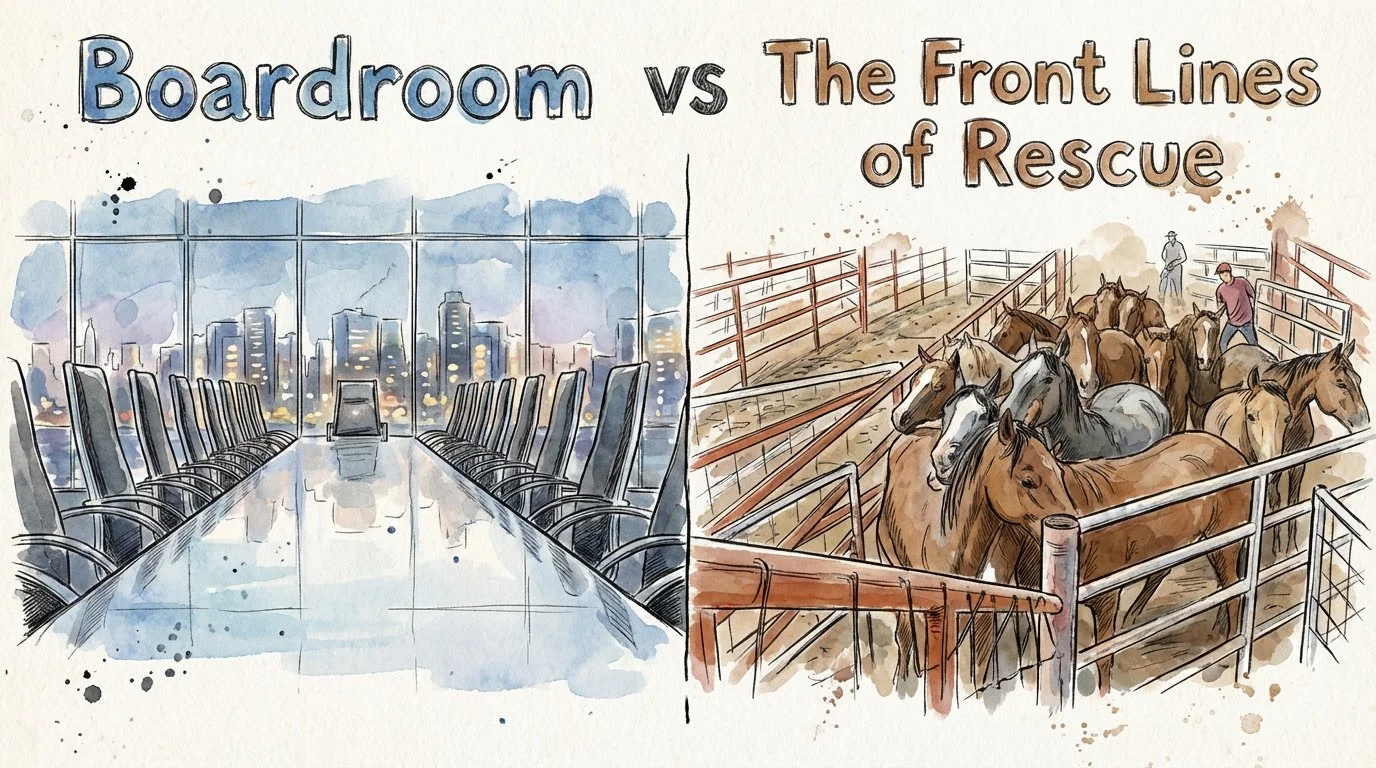
If you find yourself about to say…
"I don’t support kill pens because the ASPCA tells me not to,"
Please realize that was their $61 million advertising budget designed to make you think they are the "top dog" of the rescue world. They are experts in marketing; we are experts in the heartbeat of the horse. Until the laws in America change and horses are no longer viewed as disposable "livestock," we will be right here—intercepting the souls the world tried to throw away.
At Karma Ranch, no life is a waste of resources, and no soul is "too far gone." Every single one of them is worth the price of the exit.
In the world of animal advocacy, we are often told to look toward the "giants" of the industry—multi-million-dollar organizations like the ASPCA—for the final word on ethics. They publish sleek guides and policy papers discouraging the public from bailing horses, treating the rescue of a sentient life as a "bad investment" that "fuels a cycle."
The ASPCA’s official position states that bailing horses "fuels a cycle of exploitation" and is a "misguided" use of donor funds. They argue that the money is better spent on "long-term systemic change."
Our Response: It is easy to prioritize "systemic change" when you aren't the one looking into the eyes of a pregnant mare in a kill pen. While they wait for the system to shift, we are busy saving the lives the system has already discarded.
But there is a reality that the ASPCA doesn’t mention in its $61 million advertising campaigns. When you look at the 2023 IRS filings for the ASPCA, a startling picture emerges of where "donor dollars" actually go. While they tell small rescues that bailing a horse is "unethical," the ASPCA reported raising $379 million in a single year. Of that, they spent a staggering $151 million on staff compensation.
The contrast becomes even clearer when you look at the top:
• The CEO’s Paycheck: While you are scraping together $800 to save a life, ASPCA President Matt Bershadker received $1,203,267 in total compensation for 2023 alone.
• The "Donor Acquisition" Machine: The ASPCA paid five outside marketing firms over $61 million just for "donor acquisition" and "engagement."
• The Reality of Care: Despite having over $553 million in net assets, this massive organization spent only $16 million on veterinary medical services and operating supplies—and a mere $7 million on grants to other animal organizations.
This is the fundamental disconnect.
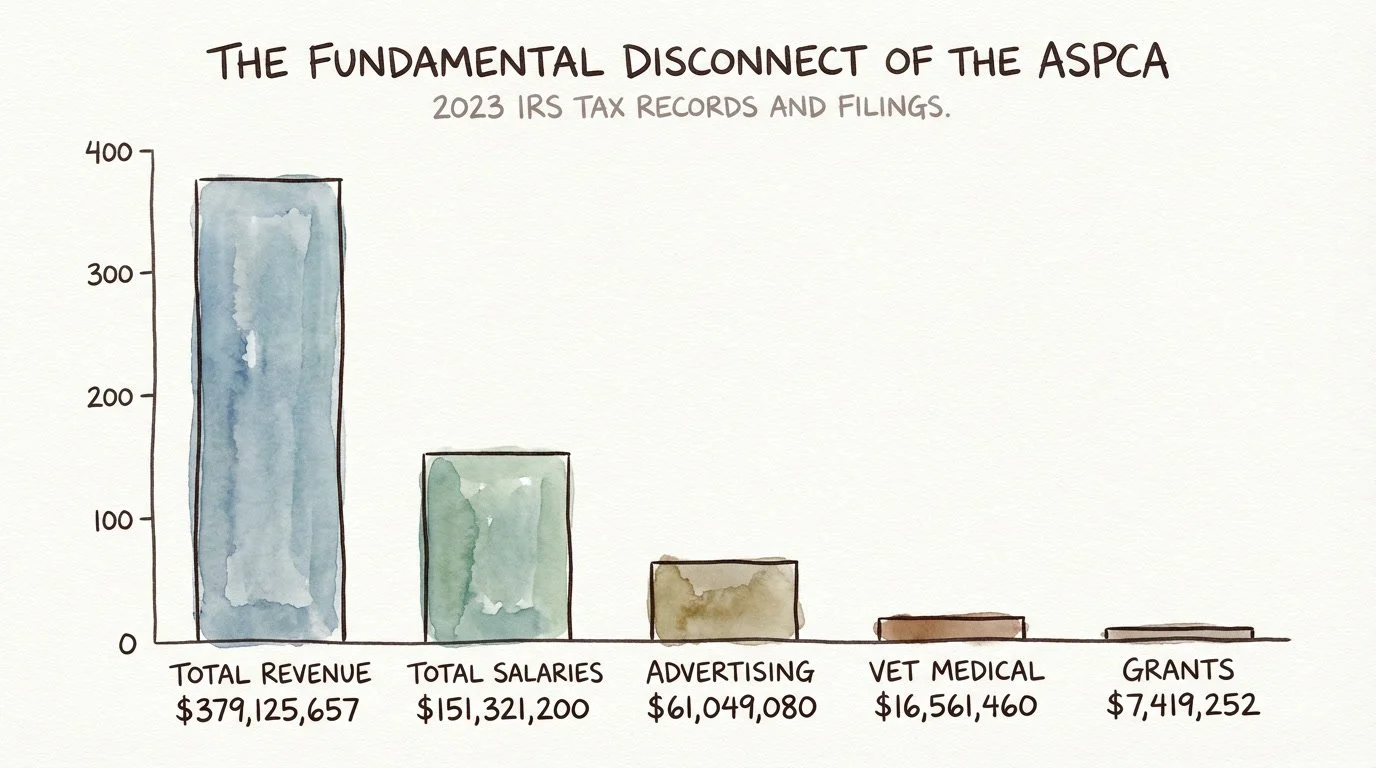
It is important to make a vital distinction: the National ASPCA (based in NYC) is a separate entity from your local, independent SPCAs. While local chapters are often in the trenches doing incredible work with limited funds, the National organization operates on a different plane of corporate finance.
The ASPCA spent nearly five times as much on advertising and promotion ($61 million) as it did on actual veterinary care ($16 million). It is very easy to write a policy paper about why a horse in a kill pen shouldn't be "bailed" when you are sitting in a boardroom in New York City, supported by a million-dollar salary. It is easy to call a life a "commodity" when your primary business model is "donor acquisition" rather than daily husbandry.
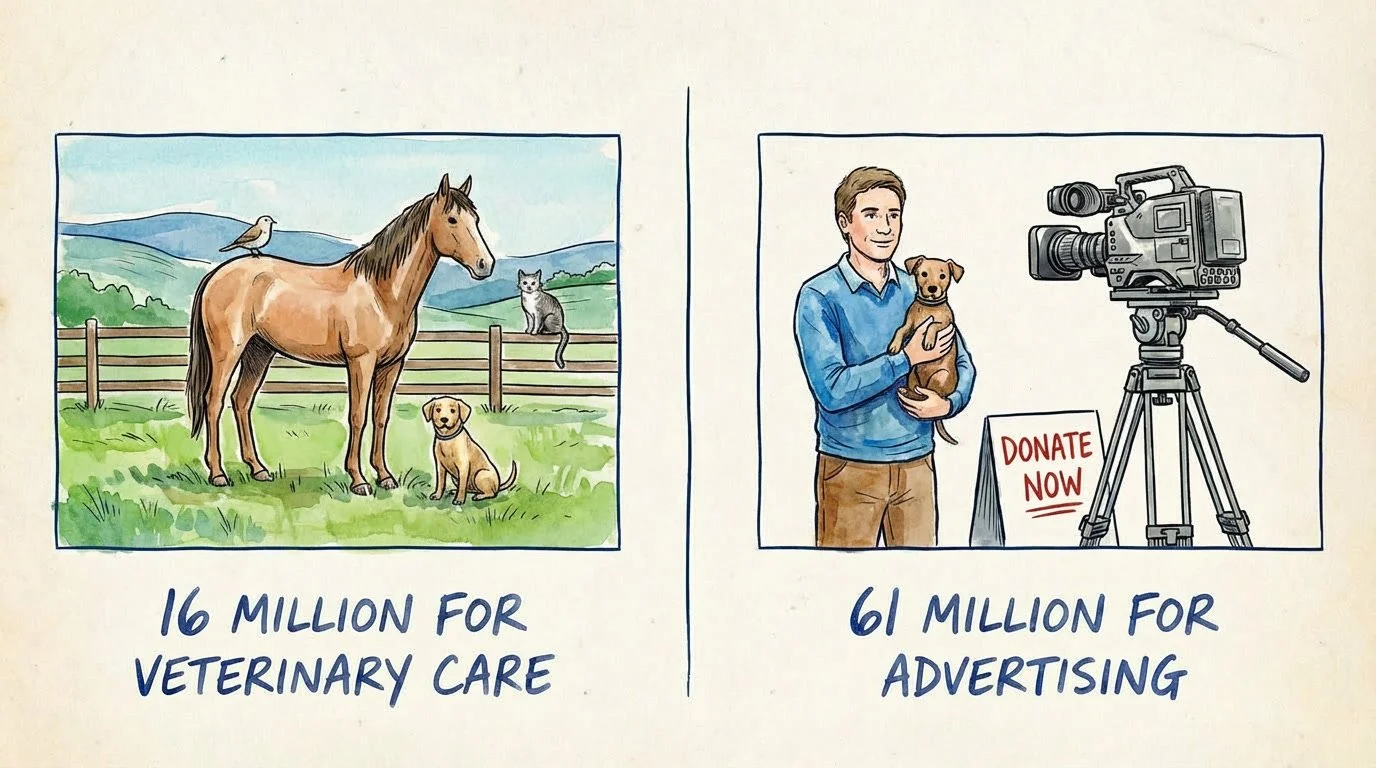
At Karma Ranch, we don't have a $61 million marketing budget. We don't have 14 executives making a combined $7 million a year. We have a fence, a pasture, and a commitment to the living soul standing in front of us. We have the names and the heartbeats of horses like Jupiter—lives that the ASPCA’s "business math" would have left to die.
The "giants" may have the money and the marketing, but they have forgotten what it feels like to look at a horse that has been discarded by the world and say, "Not today. Not on my watch." We will take the criticism from the boardroom if it means we get to keep the miracle in the pasture.
At the end of the day, we aren't answering to a board of directors. We are answering the horses. People will continue to argue that by rescuing a horse from a kill pen, you are simply funding traders to go out and buy more. But the facts tell a different story. There is a pipeline that ends at a slaughterhouse, and those slaughterhouses pay for every horse that crosses their threshold. This cycle of slaughter exists because there is a buyer at the very end of the line—not because a rescue stepped in to save one soul from the middle of it. Until the law stops the pipeline, the cycle will continue. In the meantime, we refuse to let the individual pay the price for a system we are all working to dismantle. For them, the price of the exit is always worth it.

The reason we are speaking so candidly about this is personal. We have been harassed many times on social media by critics who cite the ASPCA as the ultimate authority on rescue. These individuals have told us, based specifically on ASPCA guidelines. That we should never have rescued mama Jupiter from a kill pen. We have been told, in no uncertain terms, that because the ASPCA labels these kill pen rescues as 'scams,' we should have let Jupiter and her unborn baby die to satisfy a corporate economic theory.
When an organization with over $639 million in net assets writes a policy that is used to justify the death of a sentient being, we have a moral obligation to look at the people writing those policies.
Source (Financial data sourced from the ASPCA 2023 IRS Form 990, filed on November 4, 2024)
Key Data Points from this 2023 Filing:
Total Revenue: $379,125,657 (Page 1, Line 12)
Total Compensation (Salaries, Other Compensation, Employee Benefits): $151,321,200 (Page 1, Line 15)
Advertising and Promotion: $61,049,080 (Page 10, Line 11)
CEO Compensation (Matt Bershadker): $1,203,267 (Page 7, Section A)
Veterinary & Medical Services/Supplies: $16,561,460 (Page 10, Line 13 + Line 24a)
Grants and Other Assistance (to domestic organizations): $7,419,252 (Page 10, Line 1)
To be clear: we acknowledge the vital work that massive organizations like the ASPCA do in the halls of government. They have the resources to fund legal departments and lobbying efforts that push for systemic, long-term legislative change—work that is undeniably necessary for the future of all animals.
But laws don't feed horses today.
While they focus on the 'macro' of the legal system, Karma Ranch is focused on the 'micro' of the individual soul. We believe that a movement for change must have both the lawyers in the boardrooms and the rescuers in the trenches. One should not be used as an excuse to ignore the other. We will continue to cheer for the legal wins that protect the species, but we will never stop paying the 'price of the exit' for the horse standing in the dark right now.
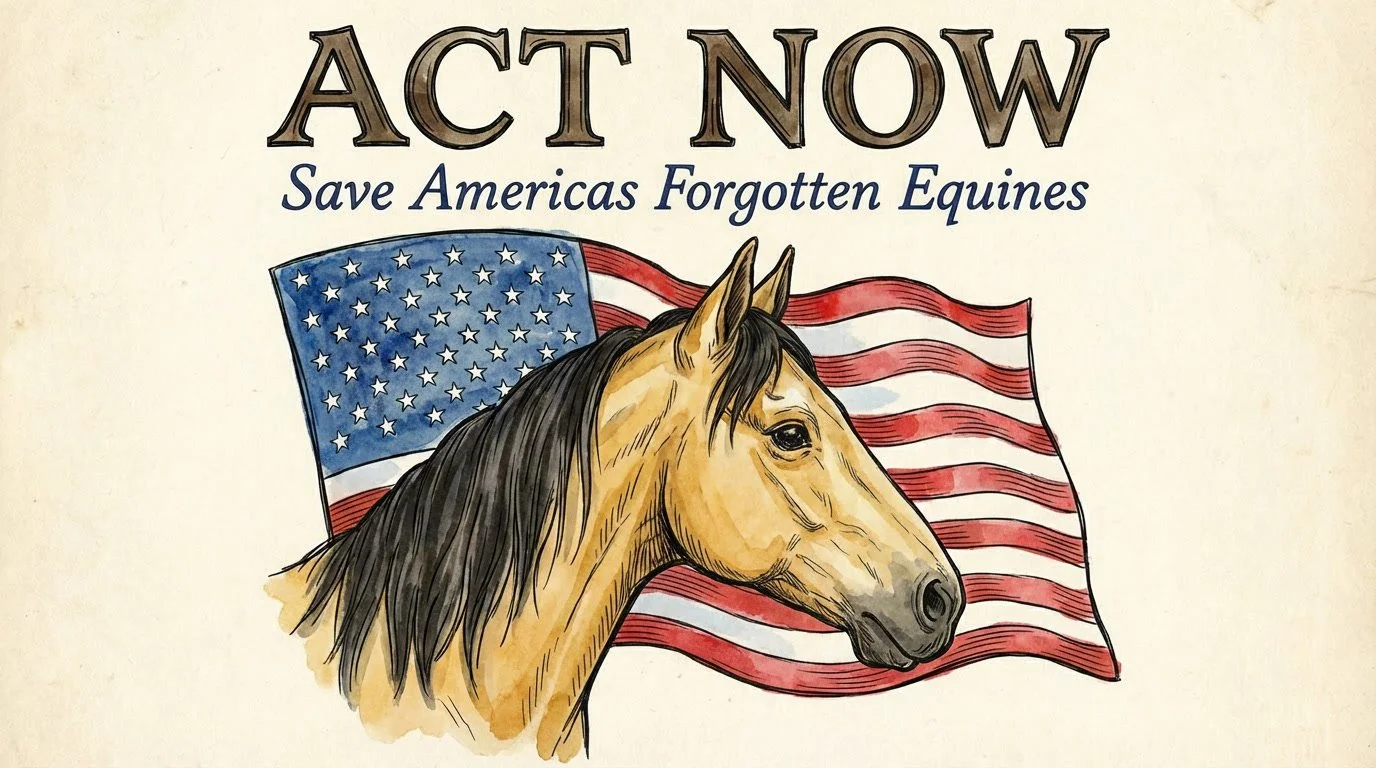
The Final Step: Closing the Pipeline Forever
While individual rescues are the boots on the ground, we also need to change the sky beneath them. Currently, horse slaughter is only "effectively" banned in the U.S. because of a temporary budget loophole that must be renewed every single year. The SAFE Act (Save America’s Forgotten Equines) is the bipartisan legislation that would finally make this ban permanent and, more importantly, prohibit the export of American horses across our borders to slaughterhouses in Mexico and Canada. It is the "Holy Grail" of equine legislation. If you want to stop the 2:00 AM emergency calls and the heartbreak of horses minutes away from a trailer, please go to SafeAct.org to sign the petition and contact your representatives.
We have the power to shut down the pipeline once and for all—not just for today, but for good.