The Great Manure Debate: Why Horse "Gold" is the Secret to Healing Montana’s Clay
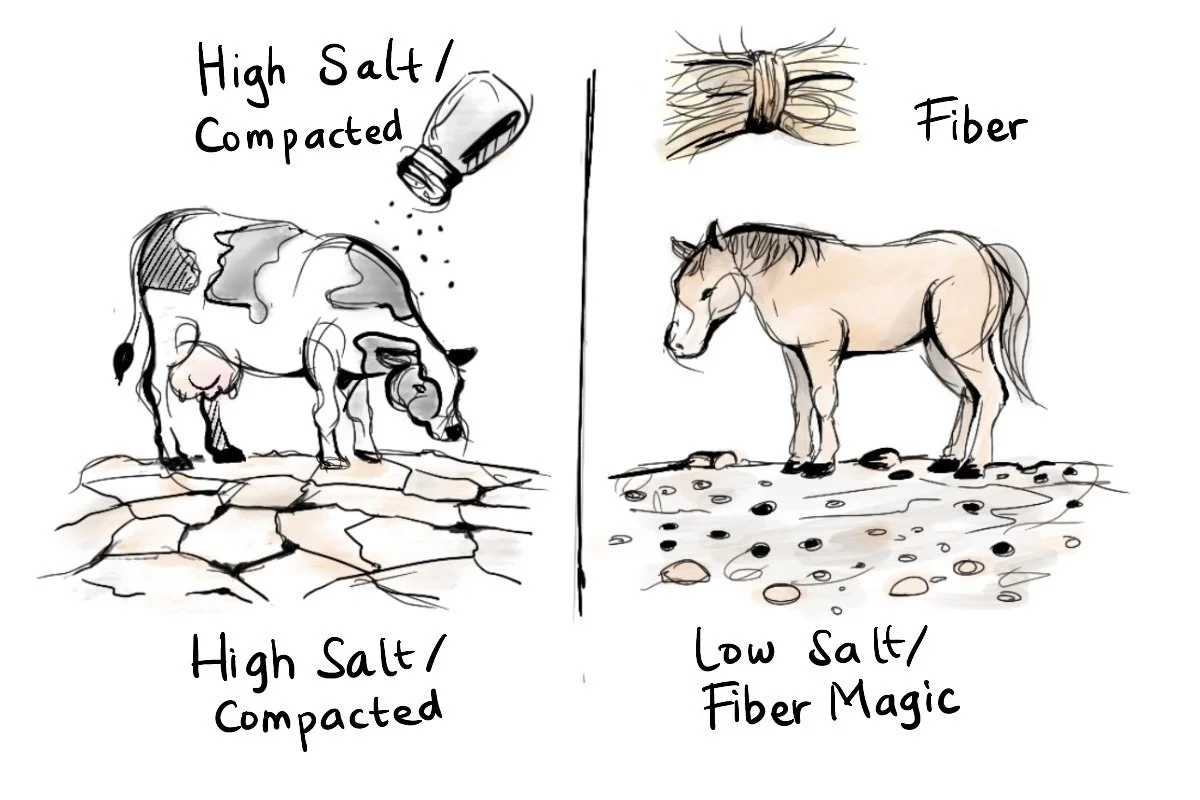
Moving from high-salt compaction to 'Fiber Magic' is a key step in our 250-acre restoration plan.
When people think of a ranch, they usually think of cattle. And when they think of fertilizer, they think of cow manure. But at Karma Ranch, as we prepare to restore 250+ acres of high-salinity, heavy-clay soil in Montana, we are taking a different path.
We aren't just rescuing 95 horses because they need a home—though they certainly do. We are bringing them home because they are the biological "engine" we need to heal a landscape stripped bare by decades of industrial grazing and tilling.
If you want to turn a "dead" clay patch into a thriving silvopasture, you have to understand the chemistry of what you’re putting on the ground. And in the battle of the brews, Horse Manure wins every single time—especially when it comes to the "Silent Killer" of Montana soil: Salt.
The Salinity Struggle: Why Cow Manure Can Be a Poison
In the high plains, salinity is our biggest hurdle. When soil has a high salt content, it becomes "sodic." This means the soil particles pack together so tightly that water can’t get through, and plant roots effectively "strangle."
Most people don't realize that cow manure is notoriously high in salts. Because of the way cattle digest—having four stomach compartments (rumens)—their waste is highly processed and concentrated. Furthermore, industrial cattle are often given salt licks and high-mineral supplements that pass directly into their waste.
If we were to blanket our 250-acre "Phase One" site with standard cow manure, we might actually be making our salinity problem worse. We would be adding salt to salty land, further "locking" the clay and making it impossible for our 14,000 trees to ever take root.
The Horse Advantage: Fiber, Biology, and Low Salt
Horses are "hindgut fermenters." They don't have four stomachs; they have one stomach and a massive cecum that breaks down long-stem fibers. This biological difference is the key to our restoration strategy.
Lower Salt Index: Naturally, horse manure contains significantly less salt than cow manure. For a project like ours, where we are already fighting saline-sodic soil, this is a non-negotiable requirement. We need to "flush" the salts out of the soil, not add to them.
The "Fiber Factor": Because horses are less "efficient" at digesting than cows, their manure is full of undigested grass fibers and organic solids. To a heavy clay soil, this is like medicine. Those fibers act as "wedges" that physically break apart the tight clay molecules, creating tiny pockets for air and water to enter.
The Fungal Engine: Trees—especially the Ponderosa Pines and Cottonwoods we plan to plant—thrive in fungally-dominated soil. Cow manure tends to be more bacterial. Because horse manure is so fibrous, it encourages the growth of beneficial mycorrhizal fungi. These fungi are the "internet of the soil," connecting tree roots to nutrients they couldn't reach on their own.
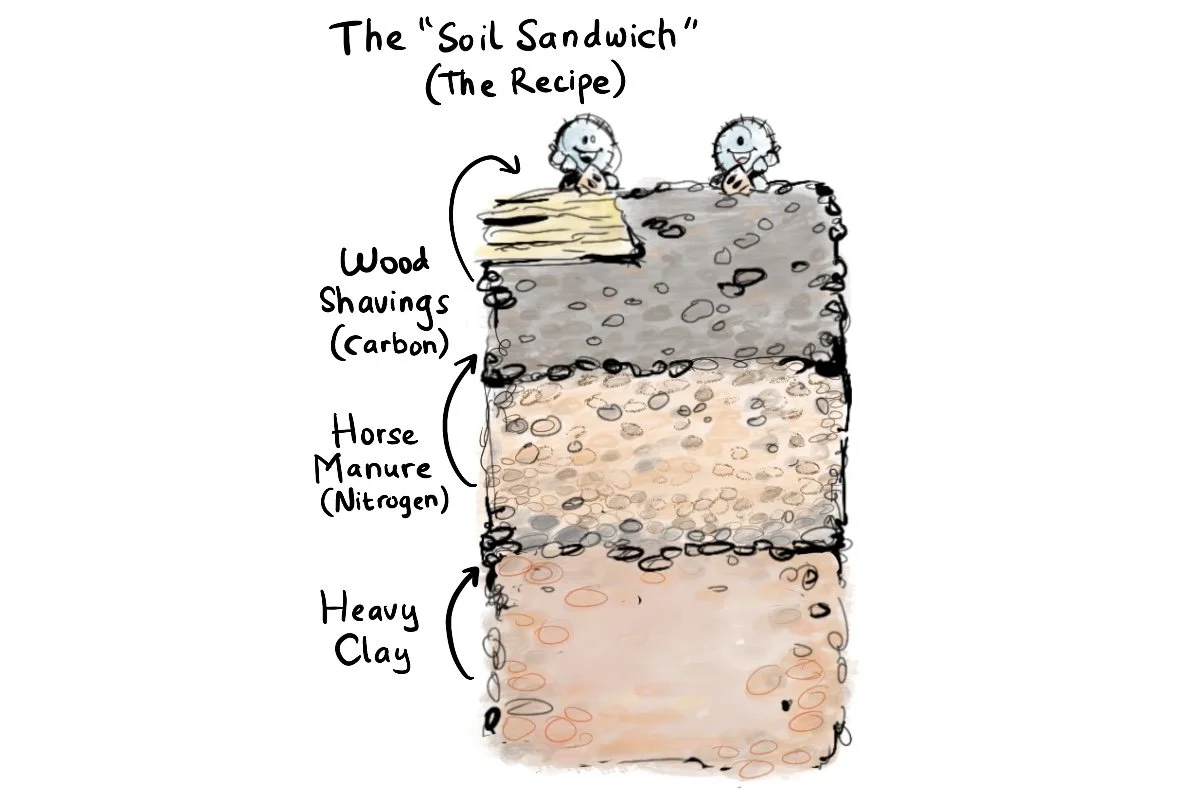
Understanding the C: N (Carbon-to-Nitrogen) ratio is vital for soil biology. This 'Soil Sandwich' method mimics the natural forest floor, using wood-based carbon and equine nitrogen to break through heavy clay layers and kickstart the humification process.
The "Manure-to-Mulch" Strategy: Building the Micro-Climate
At Karma Ranch, we don't just "dump" manure. We are creating a sophisticated "Soil Sandwich."
Our plan involves sourcing massive amounts of "waste" sawdust and shavings from local wood mills between Great Falls and Helena. On its own, sawdust is "carbon heavy" and breaks down slowly. But when you mix it with the nitrogen-rich "Gold" from our 95 rescue horses, a miracle of chemistry happens.
The nitrogen in the manure "feeds" the microbes that eat the carbon in the sawdust. This creates heat that kills weed seeds and produces a rich, dark humus. When we spread this across the barren clay patches, we are doing three things at once:
Preventing Evaporation: We are trapping the annual rainfall.
Buffering Temperature: We keep the soil cool during the 90-degree Montana summers.
Leaching Salts: The organic acids produced by this compost help break down salt bonds in the clay, allowing the salts to wash deep into the water table and away from the sensitive tree roots.
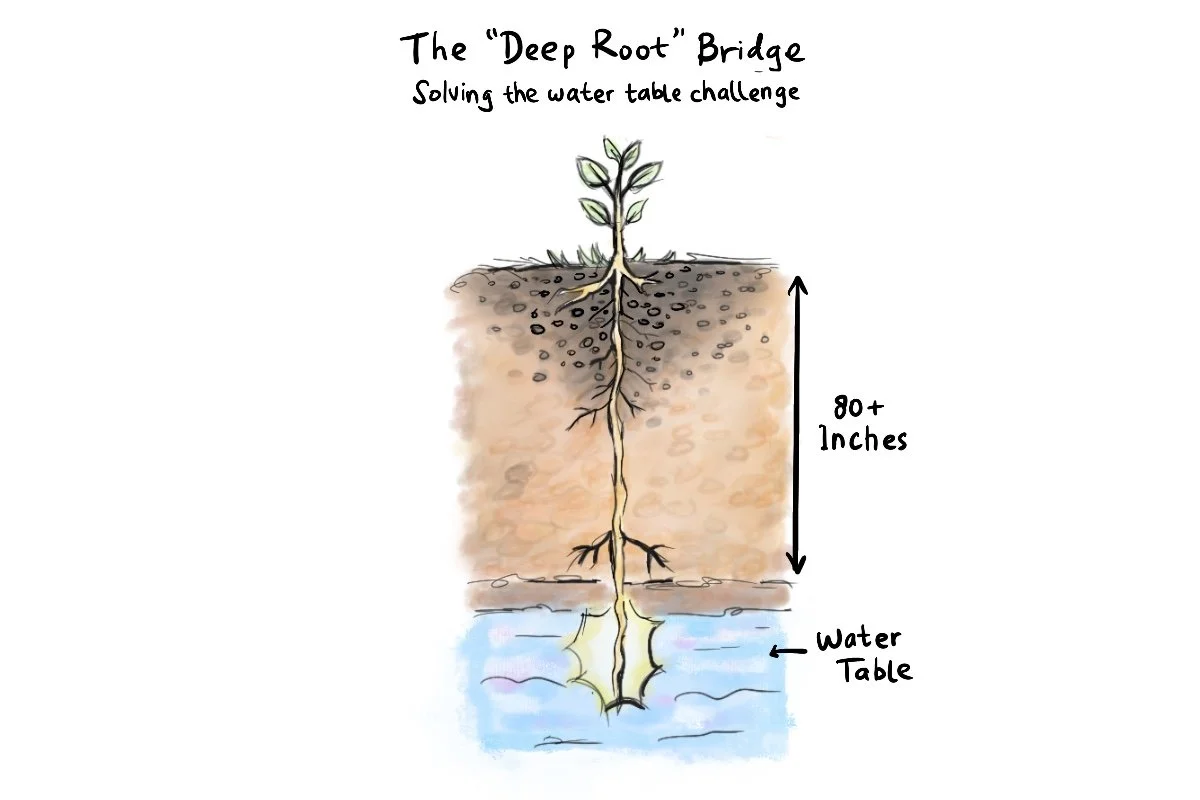
The "Deep Root" bridge is how we turn a dry clay patch into a permanent oasis. Once the roots hit the 80-inch mark, the tree is anchored for life, drawing from the deep water table to survive even the harshest Montana summers.
The "Deep Root" Bridge: Tapping Into the Hidden Reservoir
The final piece of the puzzle is vertical. In the arid landscape of Montana, the difference between a sapling that withers and a tree that thrives is its ability to cross the "No Man's Land" of compacted clay to reach the water table 80+ inches below the surface. Our Soil Sandwich serves as the launching pad for this journey. By breaking the salt lock on the upper layers of the earth, we allow the primary tap roots of our Ponderosa Pines and Cottonwoods to dive deep. Once these roots reach groundwater, the trees stop relying on us for irrigation and become self-sustaining anchors of the ecosystem. This "Deep Root Bridge" doesn't just hydrate the tree; it creates a highway for nutrients and microbes to travel between the deep earth and the surface, effectively "plumbing" our 250+ acres for long-term survival.
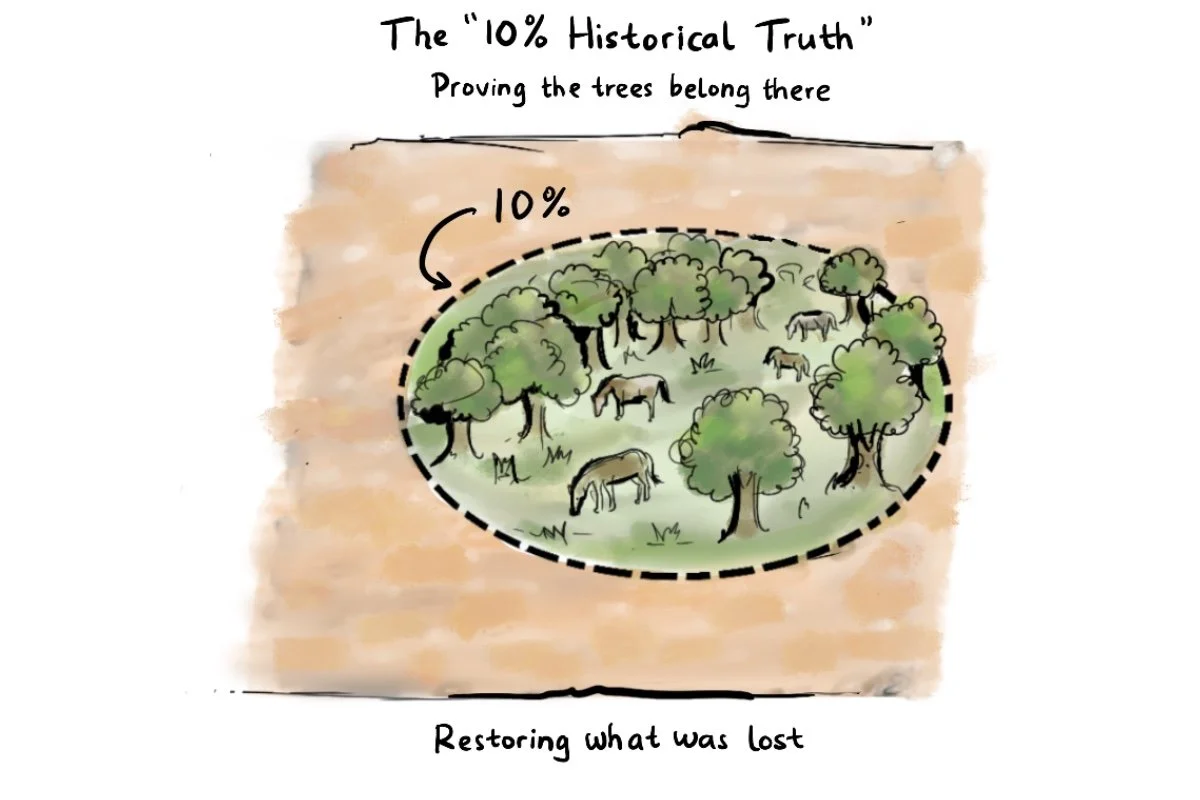
We start with the 10% Historical Truth—the proof that trees belong here. Then, we scale it to a 30–40% Savanna Canopy to create a self-cooling microclimate that protects the soil and our horses on Karma Ranch.
The "10% Historical Truth": Reclaiming and Reimagining the Landscape
When critics look at the barren clay of Cascade today and say that 14,000 trees "don't belong," they are looking at a scarred present, not the historical reality. Research reveals that at least 10% of this landscape was once a thriving silvopasture—a natural mosaic of hardy trees and rich grasslands. This 10% is our "Anchor of Truth," the biological proof that trees are in this land's DNA.
However, we aren't stopping at a simple restoration. To counter today’s rising temperatures and preserve our water table, we are scaling the historical 10% to a 30–40% Savanna Canopy. By tripling the historical density, we aren't just restoring the past; we are engineering a cooling microclimate for the future. This 40% cover provides the "broken shade" necessary to keep the soil cool and moist, ensuring that the 250+ acres of Karma Ranch become a resilient sanctuary for our horses and a model for the new Montana.
A Marathon of Healing
I was recently told that our goal of 14,000 trees is "impossible" for this type of land. They look at the historical maps from the 1950s and see a desert. But those maps are a snapshot of damage, not a limit on potential. In the 1950’s, the land had already been clear-cut and overgrazed by cattle for 70 years.
Years ago, I sat on a panel with Josh Tickell, the author of Kiss the Ground. That experience cemented my belief: You don't farm the plants; you farm the soil. We know this is a marathon. It might take us several years of just managing our horse herd and our mulch piles before we even put the first sapling in the ground. We are okay with that. We are prepared to wait for biology to catch up to the vision.
When you support Karma Ranch, you aren't just saving a horse from a bad situation. You are funding the biological machinery that will turn 900 acres of clear-cut, overgrazed, salty clay back into a thriving, carbon-sequestering forest.
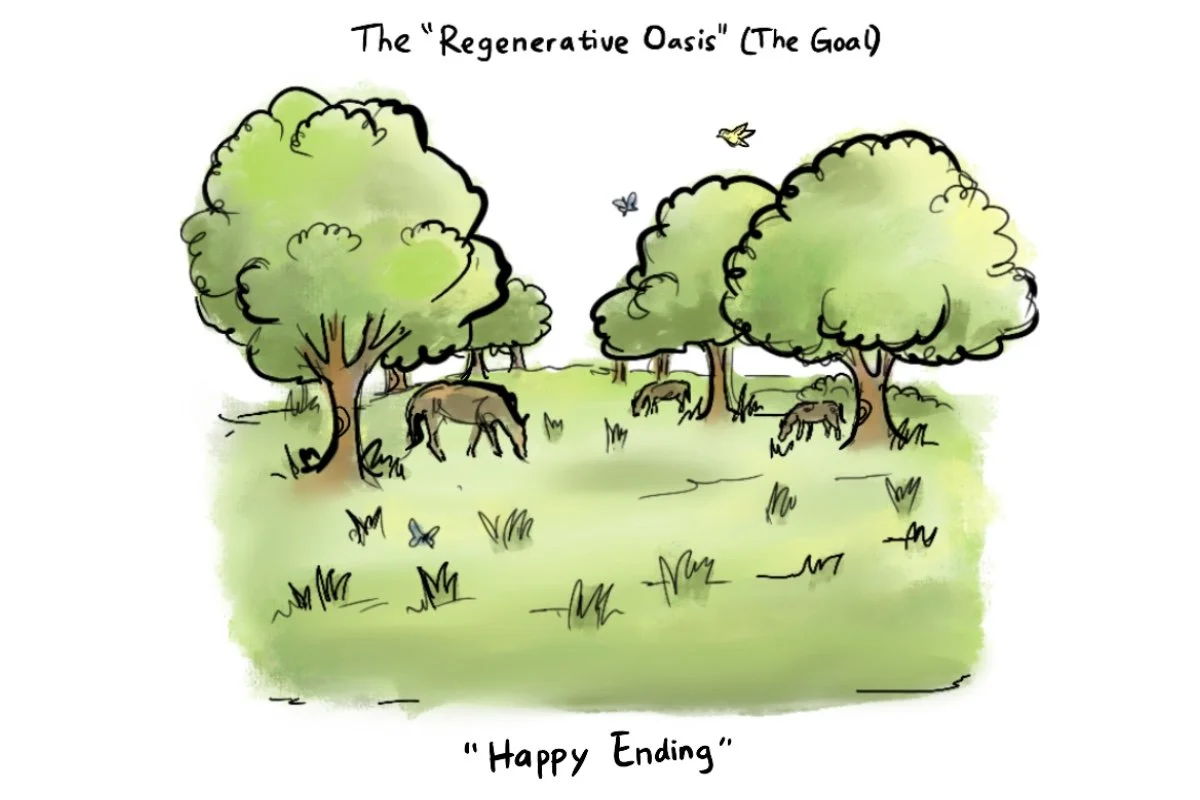
The ultimate goal of our restoration process is a resilient landscape. This "Happy Ending" features porous soil that holds water, supports shade-giving trees, and provides a healthy, natural habitat for our horses and local pollinators.
The "Sanctuary" Synergy
There is something poetic about it. The horses, who have often been "thrown away" by the traditional horse world, are the only ones capable of saving this land that was "thrown away" by industrial agriculture.
They provide the manure. We provide the mulch. Nature provides the time.
Together, we’re going to prove that there is no such thing as "dead land"—there is only land that hasn't met its horses yet

Frequently Asked Questions: The Karma Ranch Restoration Project
Q: Can trees actually grow in Montana’s saline-sodic clay?
A: While traditional "low-effort" planting often fails in these conditions, our Phytoremediation Protocol is designed specifically for high-alkaline environments. By using Siberian Peashrub and Thornless Honey Locust, we are utilizing species that naturally thrive in poor soils. These "pioneer" plants fix nitrogen and create biological "pores" in the clay, paving the way for our legacy Bur Oaks and Ponderosas.
Q: Historical maps show this area was 90% prairie. Why are you planting a forest?
A: We are designing for the climate of 2050, not 1950. As Montana faces increasing temperatures and desertification, a "business as usual" approach to grassland management leads to topsoil loss. By increasing tree cover to 30–40%, we create a microclimate that lowers ground temperatures, protects our 95 rescues from thermal stress, and acts as a windbreak for the surrounding community.
Q: Is there enough water to support 14,000 trees?
A: Our strategy utilizes a Hydrological Bridge. While we will initially truck in water to establish the "infantry" (pioneer species), their aggressive taproots are designed to reach the deep moisture levels found well below the standard 80-inch root zone. Once established, these trees perform hydraulic lift, bringing deep water to the surface to hydrate the surrounding grasses.
Q: Why not just let the Forest Service or the State handle the land?
A: Government agencies are often focused on maintaining the status quo or managing existing resources. Karma Ranch is an active restoration site. Because the state typically hires out specialized ecological consultants for "regeneration" work, we are filling that gap ourselves—combining private funding, specialized research, and hands-on management to achieve results that standard bureaucracy isn't designed to deliver.
Q: Are the chosen tree species safe for the horses?
A: Every species in our design has been cross-referenced for equine safety. We use and prioritize non-toxic nitrogen fixers, such as the Siberian Peashrub. Our goal is a symbiotic ecosystem where the trees protect the horses, and the horses (via their manure) help fertilize the trees.