The 3 Pillars of Choice-Based Horsemanship: Restoring Equine Agency
At Karma Ranch, we believe that true sanctuary isn't just about providing food and shelter; it’s about restoring a horse's agency. After years of trauma or neglect, many horses have learned "learned helplessness"—a psychological state where they believe their signals no longer matter and they simply "shut down" to survive. Choice-based horsemanship is the powerful antidote to this trauma. It is a framework that prioritizes the horse’s consent in every interaction, moving the relationship from one of control to one of collaborative partnership.
Here are the three pillars we use to guide our relationship with the herd:
1. Agency: The Right to Say "No"
In traditional training, a "no" from a horse—whether it’s pinning ears, moving away, or resisting a lead—is often labeled as "disobedience" and met with increased pressure. In choice-based horsemanship, a "no" is simply vital information about the horse's internal state. By acknowledging their boundaries, we prove that we are safe, listening partners.
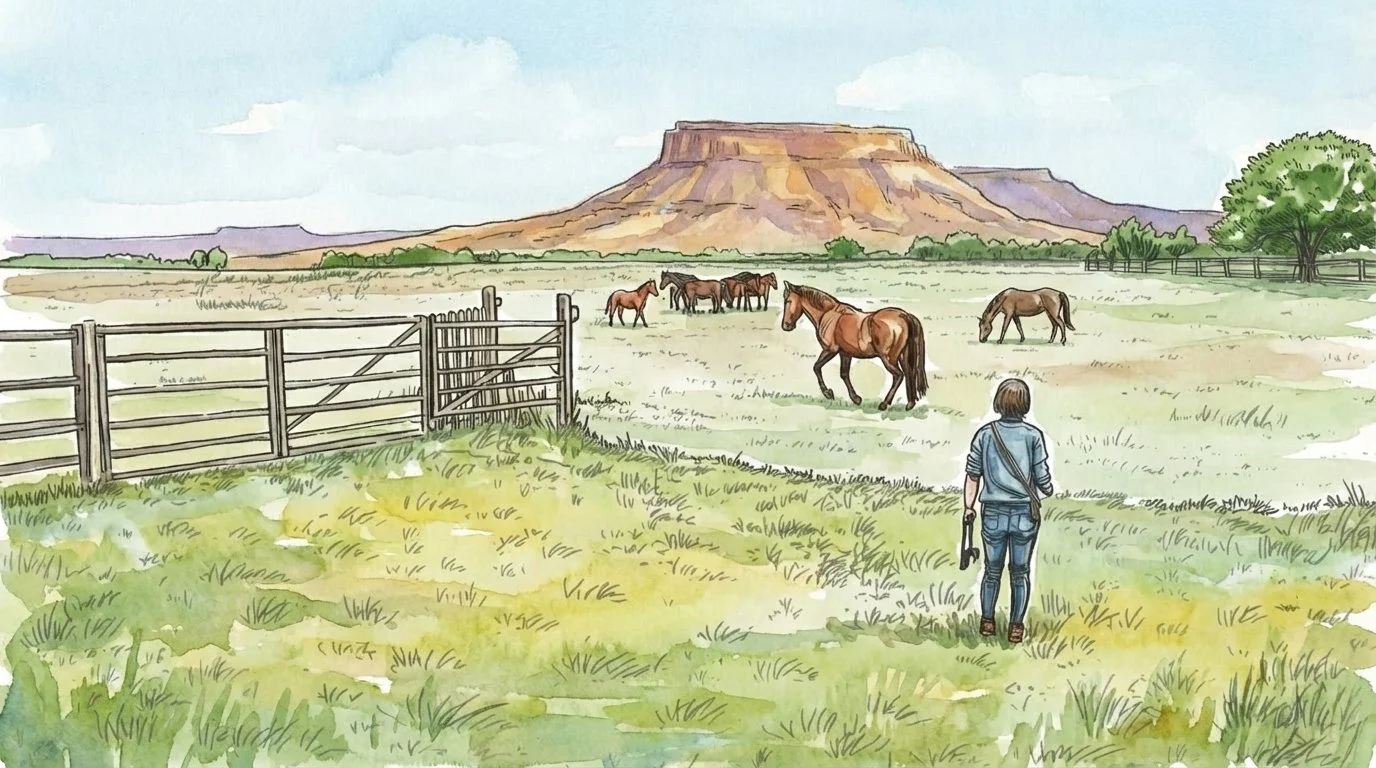
By giving a horse the space to decline an interaction—whether that’s being groomed, having their hooves handled, or going for a walk—we build a foundation of safety. When a horse realizes that their "no" is respected, they no longer need to "scream" with dangerous behaviors to be heard. Consequently, their "yes" becomes authentic and enthusiastic. At the sanctuary, we often practice "liberty starts," where we enter the field without a halter and wait for the horse to choose to approach us, ensuring every interaction begins with their explicit consent.

2. Positive Reinforcement (R+) over Pressure
Most horse training relies on Negative Reinforcement (R−), which is the removal of a stimulus (pressure) once the horse performs the desired behavior. While effective for compliance, R− is fundamentally based on the horse seeking relief from discomfort or the threat of it.
We pivot to Positive Reinforcement (R+). This means adding something the horse finds rewarding—like high-value forage, a targeted scratch in their favorite spot, or an enrichment toy—to mark a behavior we like. This shifts the horse’s brain from a state of "compliance" to a state of "engagement." They aren't working to avoid pressure; they are playing a game they want to win. This neurochemical shift from cortisol-driven movement to dopamine-driven learning is essential for the long-term rehabilitation of rescue horses who have previously known only the "pressure-release" cycle.

By utilizing Positive Reinforcement (R+), we shift the horse’s brain from a state of 'compliance' to a state of 'engagement'. This horse isn't rearing to avoid a bit or a spur; they are playing a game they want to win. At Karma Ranch, we celebrate these moments of equine sovereignty as proof that the 'Dignity of Choice' creates a bond deeper than any traditional training could achieve.
3. Species-Appropriate Environment
You cannot have ethical horsemanship if the horse’s basic biological needs aren't met 24/7. A horse kept in a stall for 23 hours a day is in a state of chronic stress, which makes "choice" impossible because their survival brain is always "on." True choice requires a foundation of physiological and psychological security.
Our regenerative sanctuary model supports this pillar by providing:
Freedom of Movement: We provide 250+ acres of Montana land where horses can move as a herd, engaging the "hoof pump" mechanism and maintaining metabolic health.
Foraging Diversity: Planting 14,000 native trees and maintaining diverse grasses allows horses to "self-medicate" and forage naturally. This variety reduces the food-anxiety and digestive issues often seen in rescues who have spent their lives on restricted diets.
Social Complexity: We allow horses to form their own family bonds (bands), mimicking natural matrilineal structures. This provides the emotional security they need to interact confidently with humans; a horse that feels safe within its herd is a horse that can choose to be curious about us.
The Future is Sovereignty
Ultimately, choice-based horsemanship is the bridge between a horse's past trauma and their future as a vital participant in a thriving ecosystem. By honoring their Agency, utilizing Positive Reinforcement, and providing a Species-Appropriate Environment, we are doing more than just "training"—we are restoring the dignity of a species that has given so much to humanity. On our 250+ acres, this philosophy ensures that every horse is not a tool for our recreation, but a sovereign being who contributes to the rhythmic heartbeat of the Montana wilderness. When we stop asking what a horse can do for us and start asking what we can do for the horse, we unlock a 30-foot field of healing that changes us just as much as it changes them. We invite you to join the herd and stand with us in this quiet, powerful space where every "yes" is earned, and every life is valued simply for existing.